When we started planning this series, the obvious way to split it was by age. Book one for three-year-olds, book two for four-year-olds, and so on up the shelf. That is how most things for children are organized, and there is a reason: it makes shopping easy.
We did not do it that way, and it is worth explaining why.
Age is a shipping label, not a description
A four-year-old who counts confidently to twenty and a four-year-old who is still working out which pile is bigger are the same age and nowhere near the same place. Buy them the same book and one is bored by page three while the other quietly decides math is not for them.
Worse, age labels are a trapdoor. A parent whose child is not ready for the book with their number on the cover reads that as a verdict. It is not one — but the cover does not say so.
So the four books split by what the math is doing, not by how many birthdays have gone past. The series spans roughly ages four to nine, and inside each book a short page tells you when to move on: about seven or eight out of ten going on their own, and your child able to explain at least some of them. Not a birthday.
Four operations, four places
- Book 1 · The Forest — adding. Things get collected. You put one more acorn in the basket and now there are more. Adding comes first because it is the operation children meet without being taught.
- Book 2 · The Meadow — taking away. Things leave on their own here. Taking away has three different meanings and most worksheets teach one: how many are left, how many more do we need, how many more does this row have. A child who knows only the first will freeze on word problems, and the reason will not be the arithmetic.
- Book 3 · The Farmyard — equal groups. Pens, baskets, and the same number in each. Twelve eggs, three baskets: how many in each? Twelve eggs, three to a basket: how many baskets? Same numbers, same sign, and the answer means something different each time.
- Book 4 · The Backyard — sharing one thing. Halves, thirds, quarters. This is where the ground shifts: one thing becomes several, and the result is smaller than what you started with.
Why the places, and not just chapter numbers
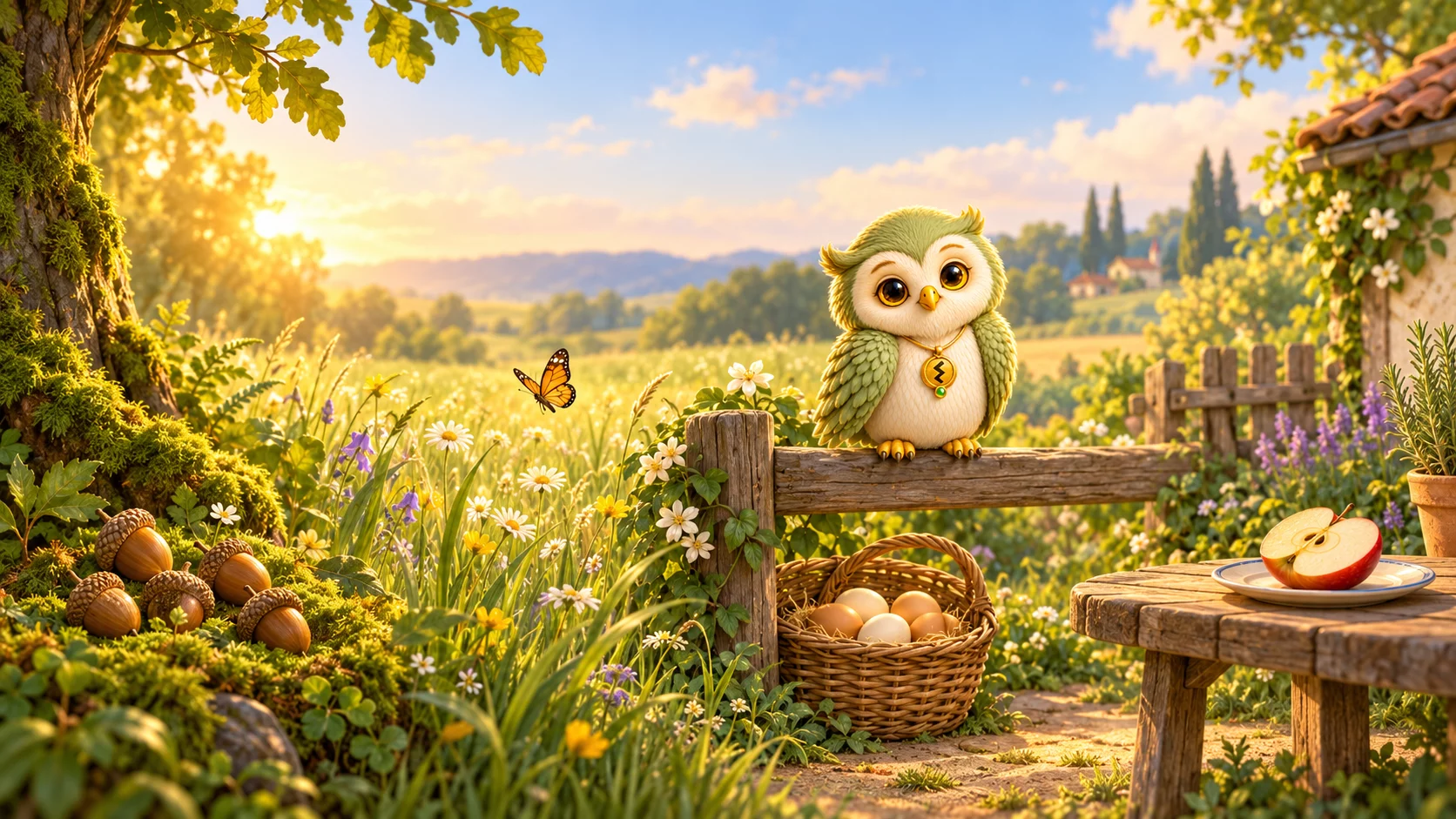
A child who has spent three weeks in the forest recognizes it. When the acorns and baskets come back on a later page, they arrive with everything already attached — this is the place where things get collected.
That saves a step every single time. And when the meadow opens and things start flying away instead, the change of place does the work of an explanation.
The four places are not decoration. Each one is a picture of what its operation does. The same thinking runs through the single-page printables, where one worksheet asks for one thing.
What repeats in every book
Each book carries its own short set of parent pages, so a book works on its own even if it is the only one you ever print. The fifteen-minute rhythm is in all four. So is the page on when to come back, because spacing is the part most likely to get dropped, and it is the part that does the work.
The three directions repeat too — forward, backward, sideways — with the same letters marking the tasks, so by the third book you can see at a glance which direction a page is asking in.
And every book ends the same way: one page with no right answer at all. If you want the reasoning behind those choices, we wrote it down in how we make these.
Where to start
With whichever operation your child is closest to, not with book one by default. If they are joining groups already but stumble when something is taken away, the meadow is your book. Nothing is lost by skipping ahead and nothing is lost by going back.
The order on the shelf is our order. Yours can be different.
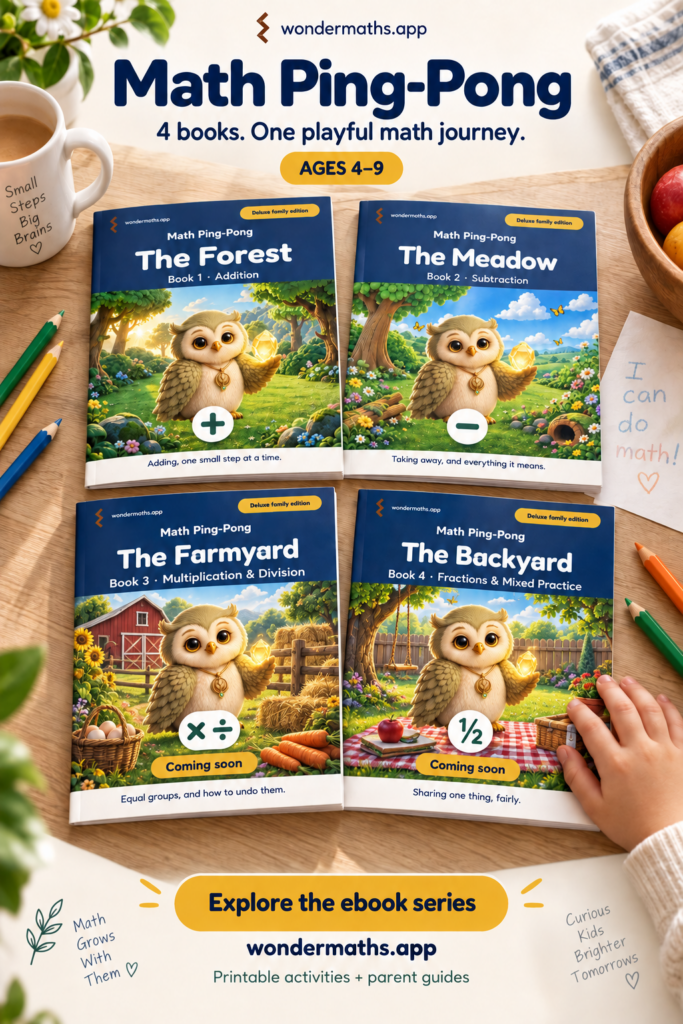
Math Ping-Pong · Book 1 · The Forest is ready. Books 2, 3 and 4 follow as they are finished — the same fifteen minutes, the same three directions, a different place.
Nineteen pages, US Letter · No reading required · Prints clean in black and white · One task per page