
It is six in the evening. Dinner is somewhere between the pan and the table, and you have fifteen minutes before everything else starts.
That is enough. Not a compromise version of enough — actually enough, as long as the fifteen minutes have a shape.
Most of it is not new material
The instinct is to spend the whole session on the thing your child cannot do yet. It feels efficient. It is the fastest way to end the evening with both of you frustrated.
Roughly three of the fifteen minutes carry something new. The rest is return, practice and one question at the end that has no number in it at all.
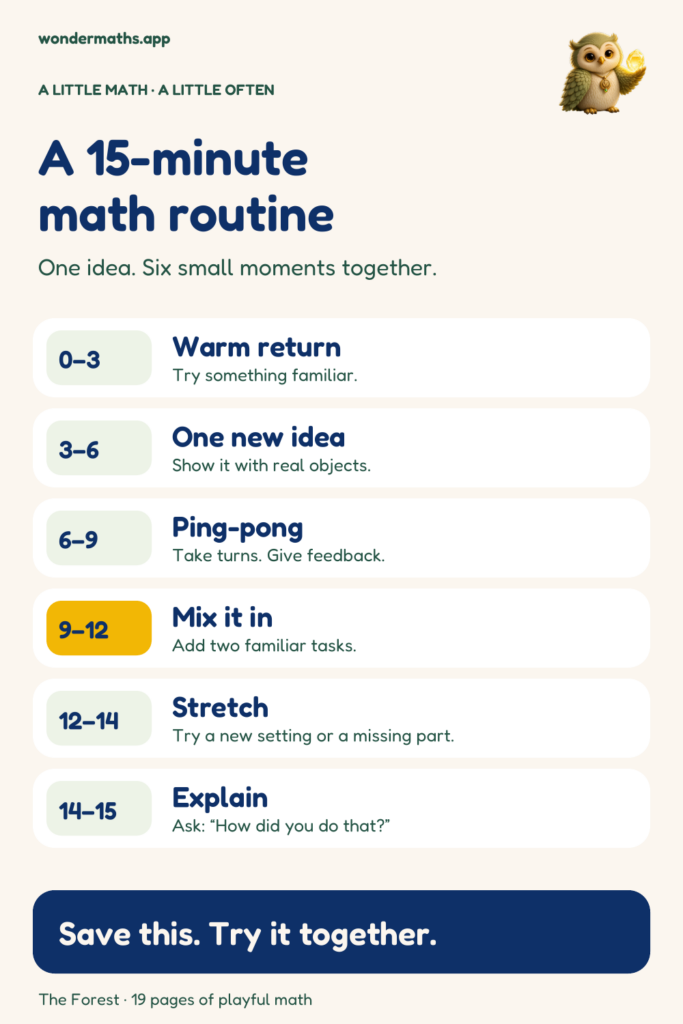
The six moments
- 0–3 · Warm return. Four to six quick questions from earlier days. Do not remind them of the rule first — the remembering is the point.
- 3–6 · One new idea. Just one. Shown once, slowly, all the way through, with real objects before anything is written.
- 6–9 · Ping-pong. You ask, they answer or fill in the missing step, and you say right away whether it worked. Back and forth, no long turns.
- 9–12 · Mix it in. The new task plus two older ones, shuffled. Your child decides which is which, and that decision is half the work.
- 12–14 · Stretch. One task in a new setting, running backward, or drawn instead of spoken.
- 14–15 · Explain. “How did you do that?” Then wait. The pause feels long and it is where the thinking becomes visible.
Why mixing beats blocking
Twenty problems of the same kind in a row feel productive. Your child gets faster as the page goes on, which looks like learning and is mostly momentum: after the third one they stop reading the question and repeat the move.
Shuffle three kinds together and the pace drops immediately. That drop is the sound of your child actually deciding what a question is asking. It is slower, it looks worse, and it lasts longer.
The last minute matters most
One question, no numbers in it: how did you do that?
A child who can answer it owns the method. A child who says “I just knew” may still own it, or may have guessed well — either way, that is the answer that tells you where to go tomorrow. It is also the only part of the fifteen minutes that cannot be replaced by a worksheet.
And if a session falls apart before minute nine, stop there. A short session that ends well is worth more than a long one that ends badly, and the single-page printables are there for the evenings when fifteen minutes is not on offer.
Eight now beats forty later
Eight problems tonight and a return in two days will do more than forty problems in one sitting. Not slightly more — reliably more, and with far less resistance.
Which raises the obvious question of when exactly to come back, and that one has its own answer. It is also the reason the order of the worksheets in Book 1 looks the way it does.
Free ebook: Math Ping-Pong · Book 1 · The Forest — the fifteen-minute rhythm is one of eight pages written for you, alongside eight worksheets and a full answer key.
Nineteen pages, US Letter · No reading required · Prints clean in black and white · One task per page