
Your child worked something out on Tuesday. When do you bring it back?
Most of us answer that by feel, which usually means either tomorrow, when nothing has had time to fade, or never, because the week filled up. Neither does much.
The gap is the ingredient
Something has to be slightly hard to recall for the recall to be worth anything. Ask too soon and your child reads the answer off the top of their memory — no effort, no gain. Wait too long and it is gone, and you are teaching it from scratch.
The right gap sits between those two, and it moves. It depends entirely on how the last attempt went.
Five cases
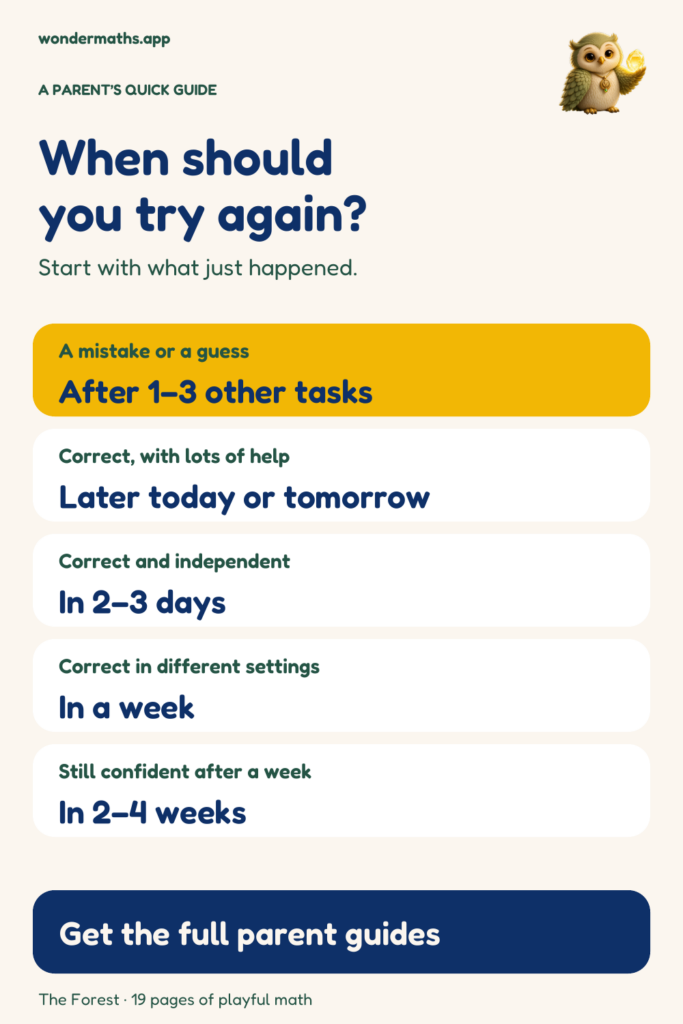
- A mistake or a guess — come back after one to three other tasks, still in the same session. Not immediately: let something else sit in between, so the second attempt is a real one.
- Correct, but with a lot of help — later today or tomorrow. What worked was partly you, and that needs testing while it is still fresh.
- Correct and independent — in two or three days. This is the one people get wrong most often, by coming back the next morning out of enthusiasm.
- Correct in different settings — in a week. If it survived a change of objects, of place, of who asked, it can hold longer than you think.
- Still confident after a week — in two to four weeks, folded into a mixed review rather than as its own task.
Forgetting a little is not a problem
When you come back after three days, your child may hesitate. That hesitation looks like the idea did not stick, and it is easy to read as a sign you moved on too fast.
It is usually the opposite. The pause is the effort, and the effort is what makes the return worth making. A child who answers instantly after three days has been given something too easy.
What this looks like in practice
You are not running five timers. You are noticing one thing at the end of a session — how did that go, roughly — and letting it set the next date.
Written down it takes one line: the idea, and when to bring it back. That line is the whole system, and it is why every book in the series carries the same page about coming back, no matter which operation it covers.
And when to stop coming back
Move on when about seven or eight out of ten go on their own, and your child can explain at least some of them. Not when they turn five, and not when the book says so.
If the number is lower than that, it is not a verdict on your child. It is a reading, and it says the same thing every time: smaller numbers, back to objects, come back sooner. The single-page printables are a reasonable place to do exactly that.
Free ebook: Math Ping-Pong · Book 1 · The Forest — the page on coming back is one of eight written for you, alongside eight worksheets and a full answer key.
Nineteen pages, US Letter · No reading required · Prints clean in black and white · Quantity first, numerals last