If your child is starting to write letters, there’s a free program from the University of Iowa that beats most worksheet sites. It’s called the Handwriting Hub, it’s run by the Iowa Reading Research Center, and it costs nothing.
The part worth stealing isn’t the worksheets. It’s the four-step routine inside, which works the same at your kitchen table as it does in a classroom.
What’s actually in the Handwriting Hub?
Free tools for pre-K and elementary kids, built for teachers and for parents. The main piece is an app called LIFTER, short for Letter Identification and Formation for Transcription and Early Reading. There’s a cursive version too, CLIFTER, for older kids.
Inside you’ll find short videos of each letter being formed, printable practice sheets, flashcards, posters, coloring pages and a training module that walks through the method. Most of it opens without an account.
Why does a reading center care about handwriting?
Because writing letters by hand helps kids read them.
When a child forms a letter, they use the shape, the movement and the name all at once. Over time that knowledge stops taking effort and settles into memory. Once it’s there, the child doesn’t have to think about the letter, which frees up attention for the harder job: reading words.
A 2022 review of handwriting studies by Ray and colleagues found that handwriting instruction in kindergarten improved writing and reading both: letter names, letter sounds, spelling and word reading. The Iowa center cites that review in its own post on why handwriting is often misunderstood, and it’s the reason the hub exists.
That’s a finding about kindergarten classrooms, not a promise about every child at home. It’s still a good reason to stop filing handwriting under busywork.
What does the routine look like?
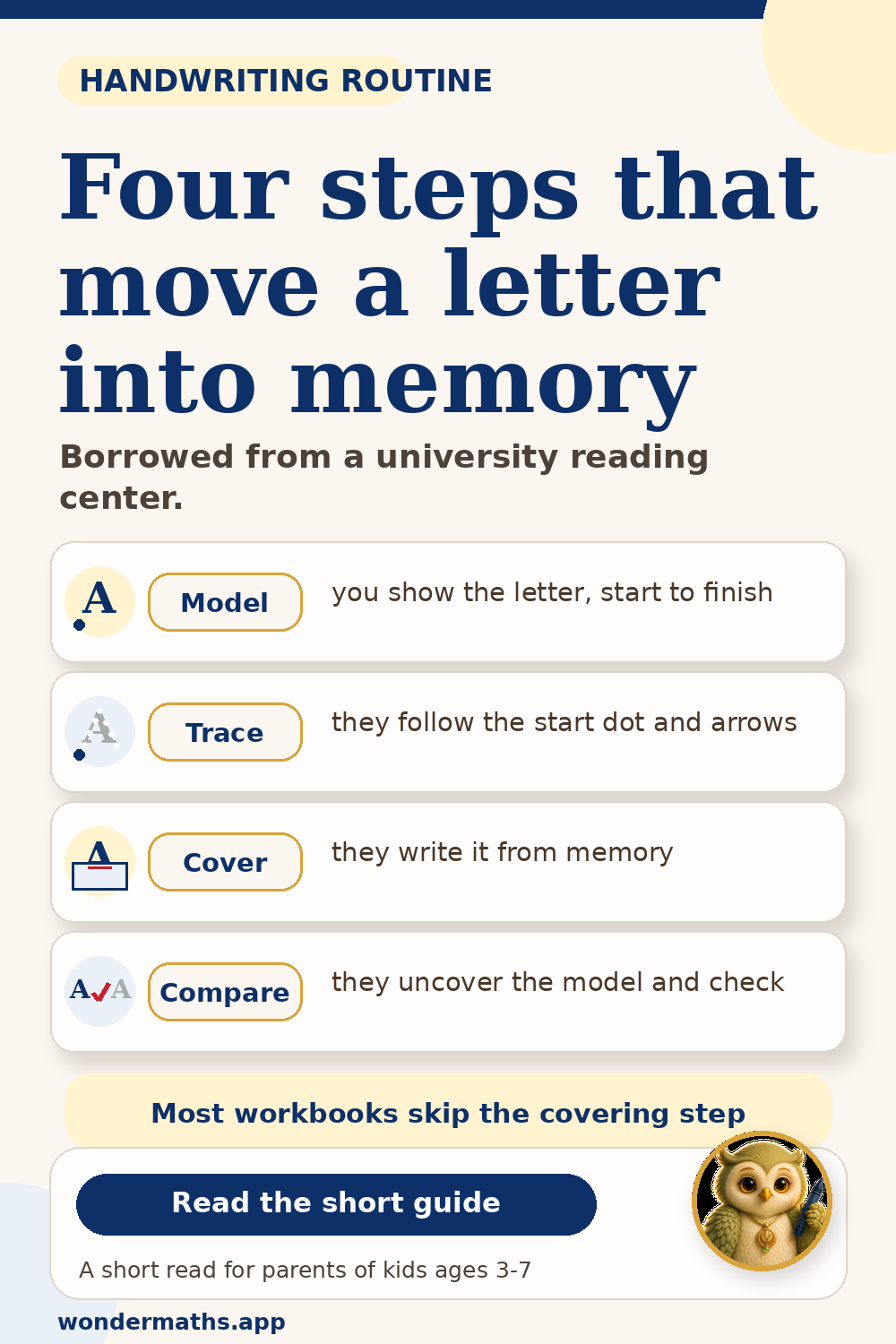
Four steps, same order, every letter. Once you’ve done one, you know them all.
- Model first. You show the letter being formed, start to finish, and name it out loud.
- All cues. Your child traces a version with a start dot, arrows and numbers. Every stroke has a place to begin and a direction to go.
- Cover, copy, compare. Look at the letter, cover it, write it from memory, then uncover and compare.
- Cumulative review. New letters get mixed with old ones so nothing quietly disappears.
Step three is the one most workbooks skip. Tracing keeps the model in front of the child the whole time, so nothing has to be remembered. Covering it is where the letter moves into memory.
Does it tell you which letter to teach first?
No, and that’s on purpose. Teachers pick the order so it lines up with whatever reading program their class uses. Letters follow the words kids are learning to read.
Numbers don’t have a reading program to follow, which is why we ordered them differently when we built the number version: straight lines before curves.
What can you do today?
Pick one letter your child already knows by name. Print the practice sheet from the hub, or draw the letter yourself with a dot where the stroke starts.
Run the four steps once. You model it, they trace it, they cover it and write it, you compare together. Five minutes. If the covered version comes out wobbly, that’s the step working, not failing.
When is it more than practice?
Wobbly letters, backward letters and a fist grip on the crayon are all ordinary at 3, 4 and 5.
If your child is 6 or older and still finds holding a crayon painful, avoids drawing altogether, or can’t copy a circle or a cross, bring it up at the next pediatrician visit or parent-teacher conference. That’s a question for someone who can watch your child, not a label.
Where do you find it?
Everything sits on the center’s own site: the Handwriting Hub at the Iowa Reading Research Center, part of the University of Iowa College of Education. It’s free, and we have no connection to it beyond borrowing the routine.
Free ebook: Count It First. Then Write It. Twenty-six pages that take a child from counting objects to writing the digit, one number at a time, in the order the hand is ready for.
Ages 3 to 7 · Prints clean in black and white · One digit per page · We send the PDF and nothing else