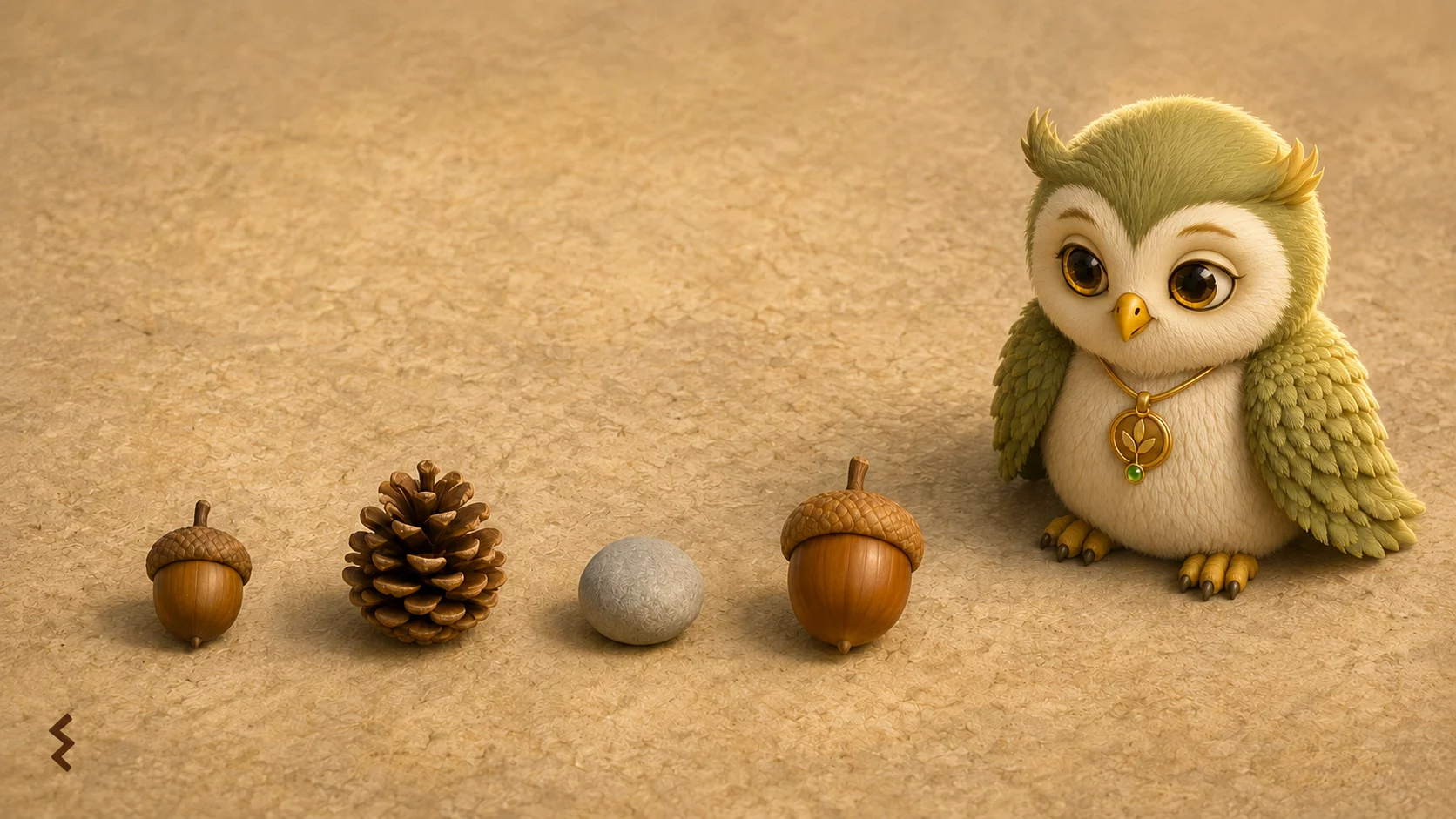
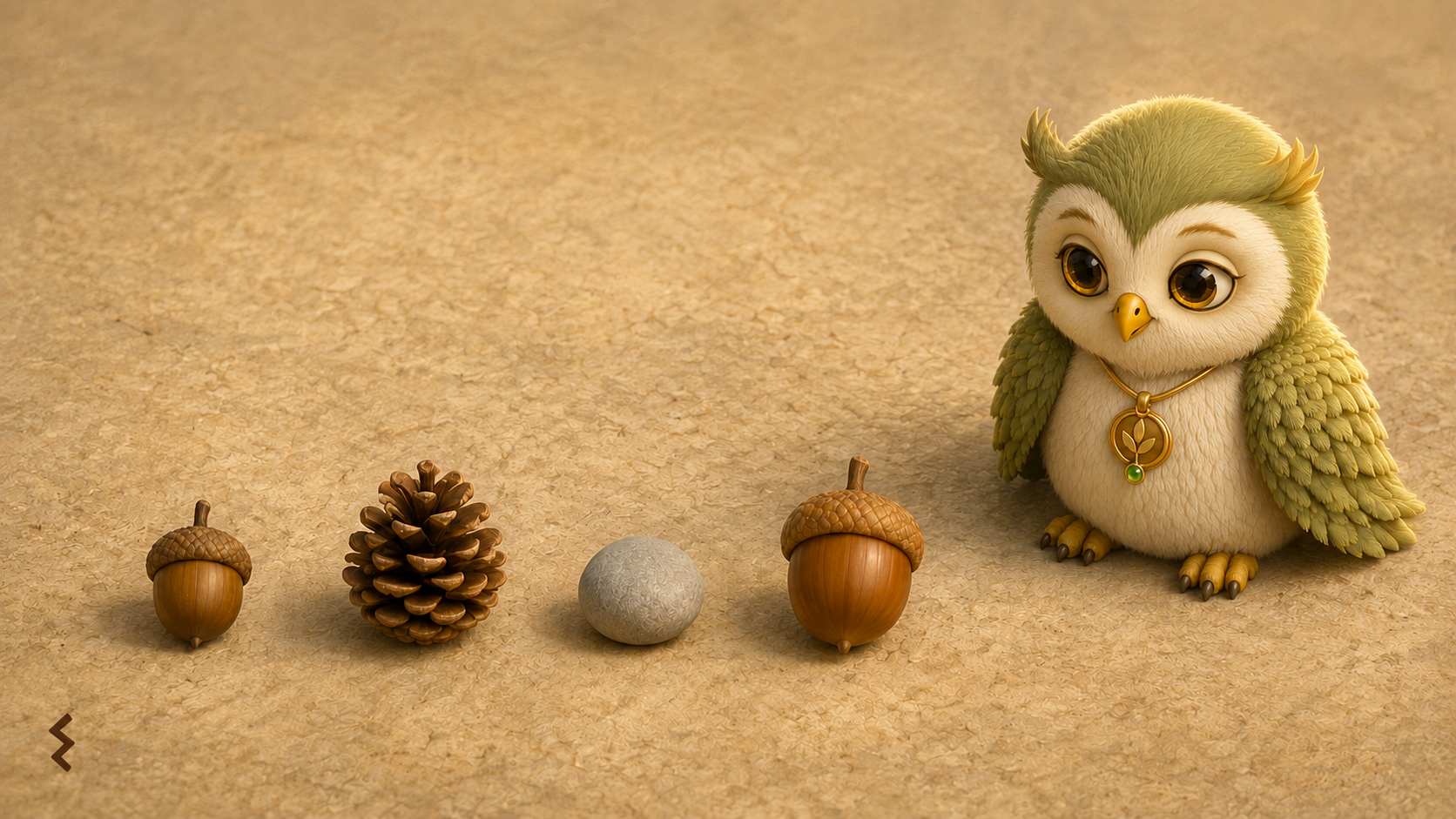
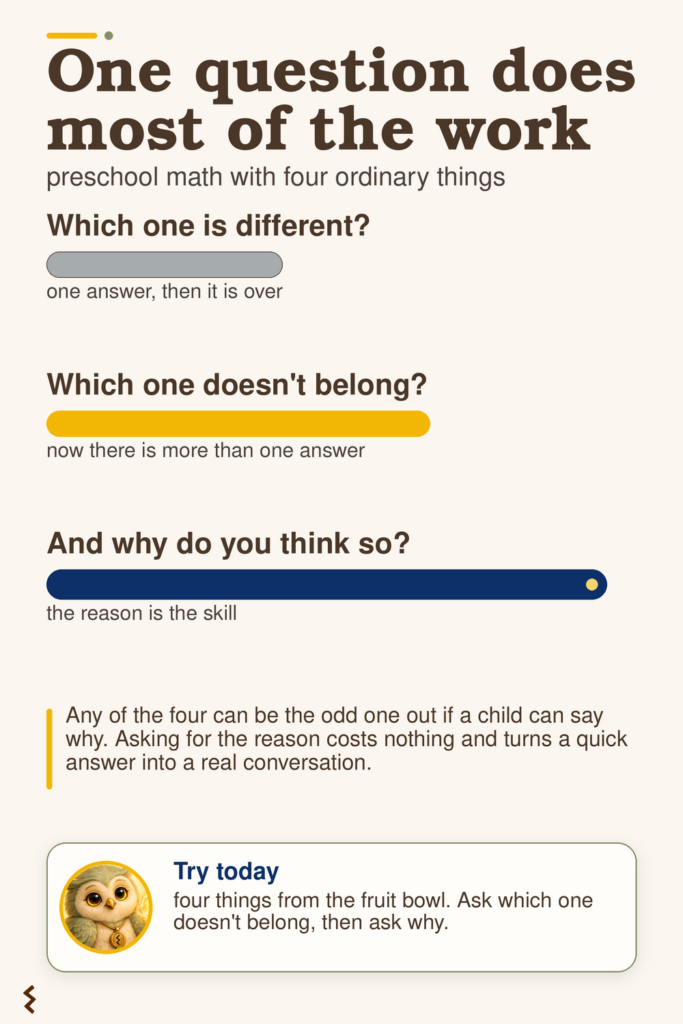
Put four things on the table. A spoon, a fork, a crayon and a second spoon that’s bigger than the first. Ask your child which one doesn’t belong.
Then, whatever she picks, ask why.
That’s the entire game. It takes two minutes, needs nothing you don’t already own, and it’s the closest thing I know to a conversation starter that happens to be math.
There’s no right answer, and that’s deliberate
The crayon doesn’t belong because you don’t eat with it. The fork doesn’t belong because it has points. The big spoon doesn’t belong because of its size. The small spoon doesn’t belong because it’s the only one without a match.
All four are correct. Every single one, as long as the child can say why.
That’s unusual for a child who’s already learned that questions have one answer and grown-ups know it. Here she gets to notice something nobody pointed at, and be right.
What she’s practicing while she argues
To answer, she has to pick a property, size, shape, color, material, what it’s for, and then hold every object up against it. That’s sorting, and sorting is what sits under almost everything that comes later.
The second thing she practices is saying why out loud. A lot of early math work asks for an answer and stops there. This one is useless without the reason, so the reason is the habit that forms.
How to pick the four things
The trick is that no object should be the obvious odd one out. If three things are round and one is square, the game is over in a second.
Aim for four things that each have a claim. Two that share a color, two that share a shape, one that’s much bigger, one that’s the only one made of metal. Overlapping is what keeps it alive.
Fruit bowl, sock drawer, the pocket of a coat, a handful from the garden. Four things, no preparation.
Where it goes next
After she’s given one answer, ask whether anything else could be the odd one out. The first time, most children say no. The third or fourth time, they start looking for a second answer before they’ve finished giving the first.
Then hand the game over. Let her choose four things and ask you. Say something wrong on purpose and watch her decide whether to accept your reason.
The thing not to say
Don’t say “not quite, look again.”
The moment one answer becomes the answer, the game turns into a guessing contest with you as the judge, and children stop offering the interesting reasons in favor of the safe ones. If her reason holds up, she’s right, even when it’s not the one you had in mind. Especially then.
The part worth remembering
You don’t need to know any math to play this, and you can’t get it wrong. If that’s a relief, you’re not the only parent who feels it, and it’s a good reason to start here rather than with something that has a marking scheme.
The same thinking runs through the math your child does with blocks and boxes and through why lining things up is math.
Free printable: Find the Acorns — four levels of searching and counting, one page each. Print the level that matches where your child actually is, not the one that matches her age.
No reading required · Prints clean in black and white · One task per page