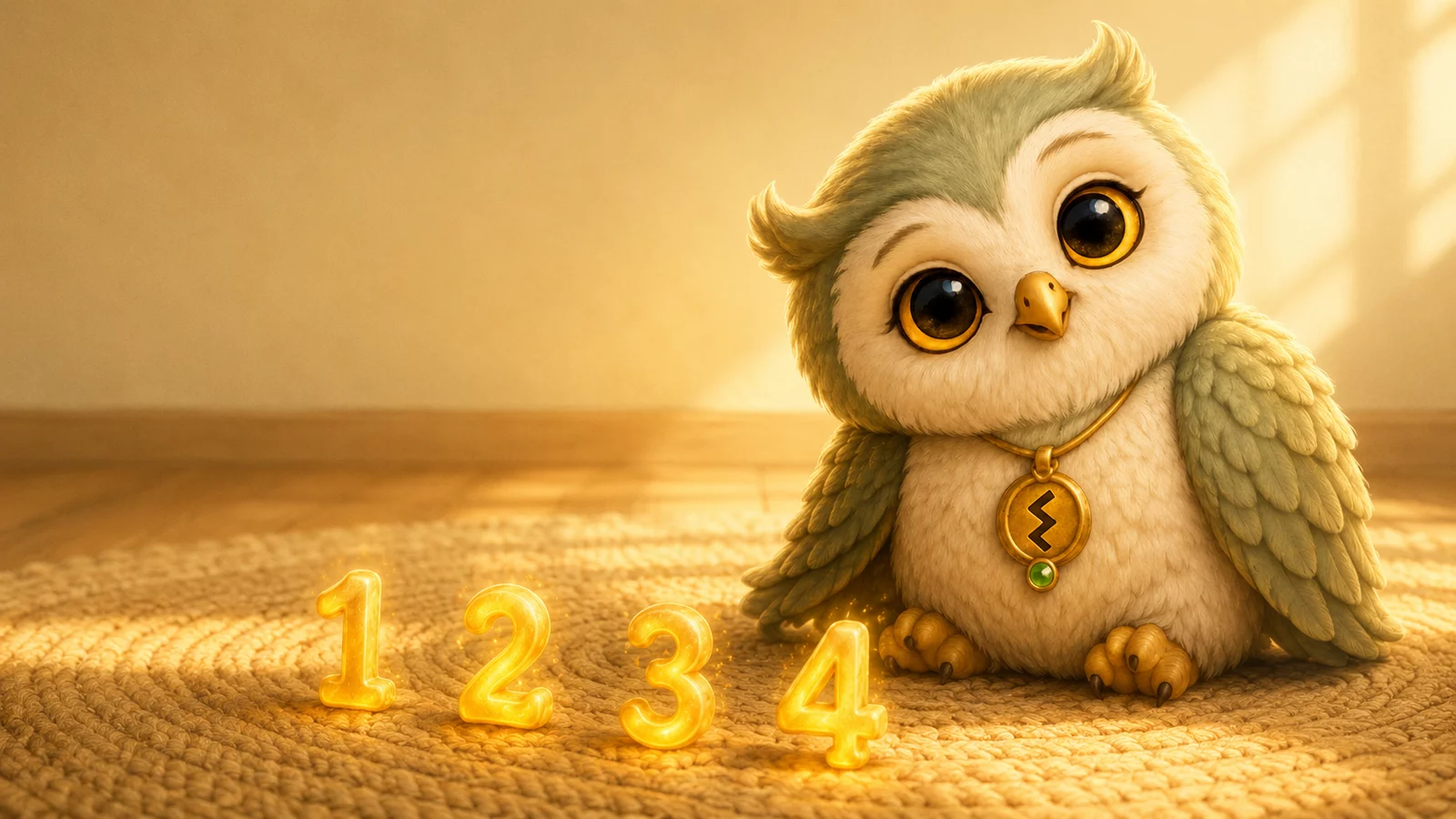
Most of us measure counting by the number our child reaches. It is the easiest thing to hear and the least useful thing to know.
A child who counts to thirty and a child who counts to seven can be in exactly the same place, or twenty steps apart. The number does not tell you which. What tells you is what the child does while counting.
Four things to watch. None of them needs a worksheet, a quiz, or a child sitting still.
The last number is the answer
Count five toy cars together. Then ask how many there are.
A child who has this looks up and says five. A child who does not have it starts over from one, because to her the question was an instruction to count again. That single moment tells you more than any recitation, and it is the difference between saying the numbers and knowing what the numbers mean.
If she starts over, nothing is wrong. She is where almost every three-year-old is. You just found out where to work.
One touch, one number
Watch the hands, not the mouth. Early on the mouth races ahead: six words come out while three fingers land. Later the two lock together, one touch for one number, and the child slows herself down to keep them matched.
That slowing down looks like getting worse. It is the opposite. She has noticed that the words are supposed to line up with something real, and she is doing the work to make them.
Starting from somewhere other than one
Put four blocks in a row, cover them with your hand, and say: there are four under here. Keep going.
A child who can pick up at five is holding four in her head as an amount rather than as a place in a song. A child who lifts your hand and starts at one is not ready, and pushing does not make her ready any faster.
This one usually arrives last of the four. If it has not shown up yet, that is not a delay. It is the order things come in.
Small amounts without counting
Three forks on the table. She glances and says three, without touching one of them.
You will see this with two and three long before you see it with four or five, and it comes and goes depending on how the things are arranged. Three in a tidy triangle is easy. Three scattered across a rug is not. Both are normal.
What to do with any of this
Nothing, on the spot. You are not testing, and a child who feels tested stops showing you what she can do.
Notice it, then aim the next few days at whichever one is missing. If the answer keeps restarting from one, count small sets and ask the question again a beat later. If the mouth is racing the hands, count things that have to be touched to move: stairs, blocks, steps across the kitchen. That kind of counting works best while the whole body is involved, not while sitting.
And if all four are there, stop checking. She has it, and the next thing she needs is more interesting numbers, not more proof.
Free printable: Ori’s Stepping Stones — five floor tiles to cut out and lay in a line. A number path your child walks and counts out loud, one jump at a time.
No reading required · Prints clean in black and white · One task per page