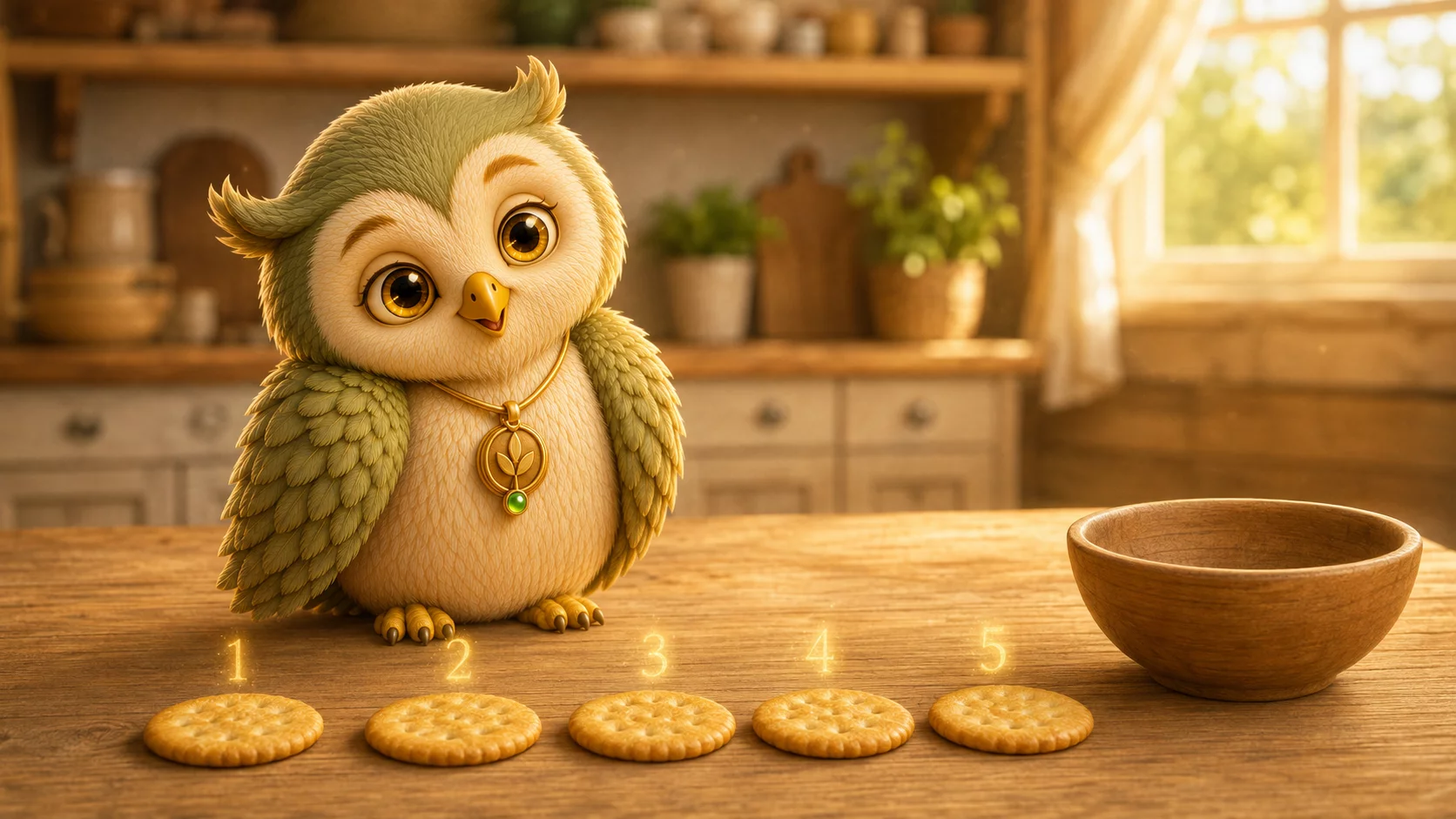
Short answer: this is common, and it’s two different skills. Saying the numbers in order is a memorized list, like the alphabet. Counting five crackers means matching one word to one cracker and knowing that the last word tells you how many. Most kids get the list first, often by a lot.
So the gap you’re seeing isn’t a problem with your child or with what you’ve been doing. It’s the normal order. Here’s how to check where she is and what to say at the table.
Why can my child say the numbers but not count the things?
Because “one, two, three” is a song, and counting is a job. The song can be sung fast and out of order and it still feels done. The job has three parts: touch each thing exactly once, say one word per touch, and then answer the question “so how many?” with the last word instead of counting again. Teachers call that last part the cardinal principle.
Researchers have found this order consistently. Kids can recite well past ten while still working out what “three” means as an amount, and the amount part comes in steps, usually one, then two, then three, then the rest. A 2011 review by Clements and colleagues lays out that path in detail. Reciting to 20 tells you about memory. It doesn’t tell you much about number yet.
How do I check in one minute?
Put about ten small things on the table. Crackers, blocks, coins. Then ask for a specific amount: “Can you give me three?”
- Hands you three: she has three. Try four, then five.
- Hands you a handful: the word “three” is a sound to her, not an amount yet. That’s where many 3-year-olds are.
- Counts out loud, then keeps going: she has the touching part, not the stopping part. Very common at 4.
Second check: let her count a row of five, then ask “so how many are there?” If she counts again from one, she’s in the middle of learning that the last number is the answer. That’s a stage, not a stall. One check on one afternoon doesn’t decide anything, so do it twice on different days before you draw a conclusion.
What helps, and what to stop doing
Finish every count with the total. “One, two, three, four. Four cups.” You say the amount again as one word for the whole group. It sounds tiny. It’s the whole idea.
Touch or move each thing. Counting into a bowl works well: each cracker gets touched once because it leaves the row. Sliding things across the table works too.
Stay small. One to five is where the work is. Counting to 100 is fun and it’s fine, and it isn’t the skill you’re after right now.
Stop correcting the recount. When she counts again instead of saying “four,” don’t say “no.” Say “you counted them, and there are four.” Then move on.
Once she’s solid on “how many,” the next question is “which has more,” and that one has its own trap. We cover it in why more or less comes before counting.
Try this today: the bowl game
Five crackers in a row. One empty bowl. Your child moves crackers into the bowl one at a time while you count together. Then: “How many in the bowl?” Eat them. Do it again with four.
Make it easier: three crackers, and you do the moving while she says the words. Make it harder: “Put three in the bowl and leave the rest.” If she loses interest at two: that’s a full round. Same time tomorrow.
Sorting comes before all of this, and if the bowl game is too much right now, shapes and space at home is a gentler place to start.
When is it worth mentioning to someone?
If a few months of this go by and nothing shifts, and it stands out next to the other things your child does, bring it up with her preschool teacher. Ask: “What do you see when she’s asked to count a small group in class?” Teachers see a room full of this age every day and will tell you quickly whether it looks like the usual range.
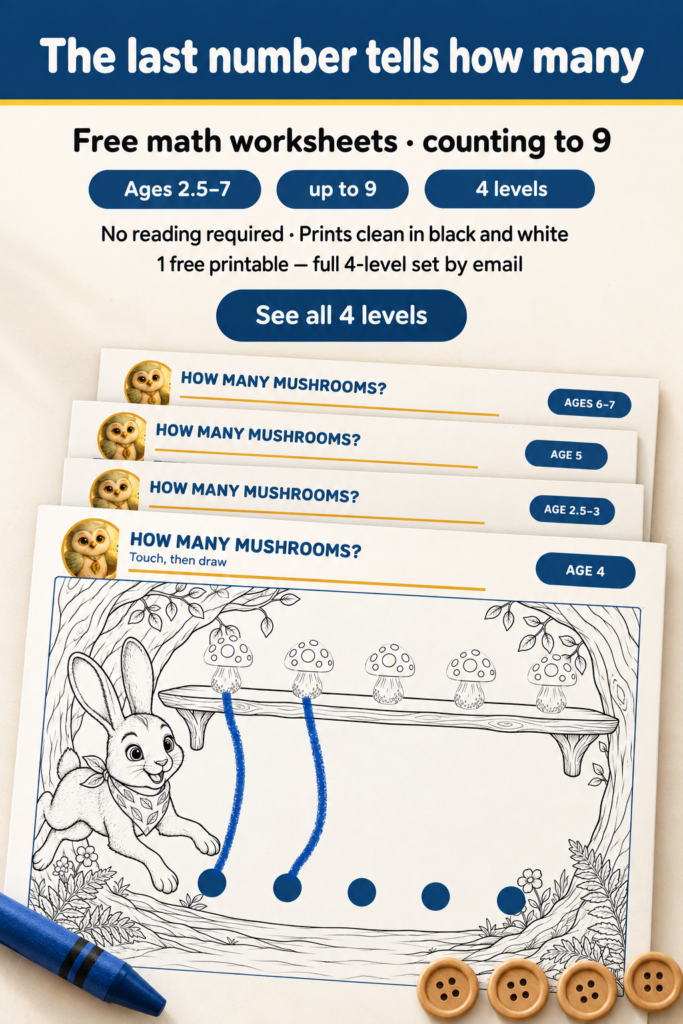
Free printable: How Many Mushrooms? — mushrooms on a shelf, a row of dots underneath. Your child touches each mushroom, draws one line from it to one dot, and says how many. Four levels from 2.5 to 7, up to 9 at the top. The age-4 page is free; the full set comes by email.
No reading required · Prints clean in black and white · One task per page