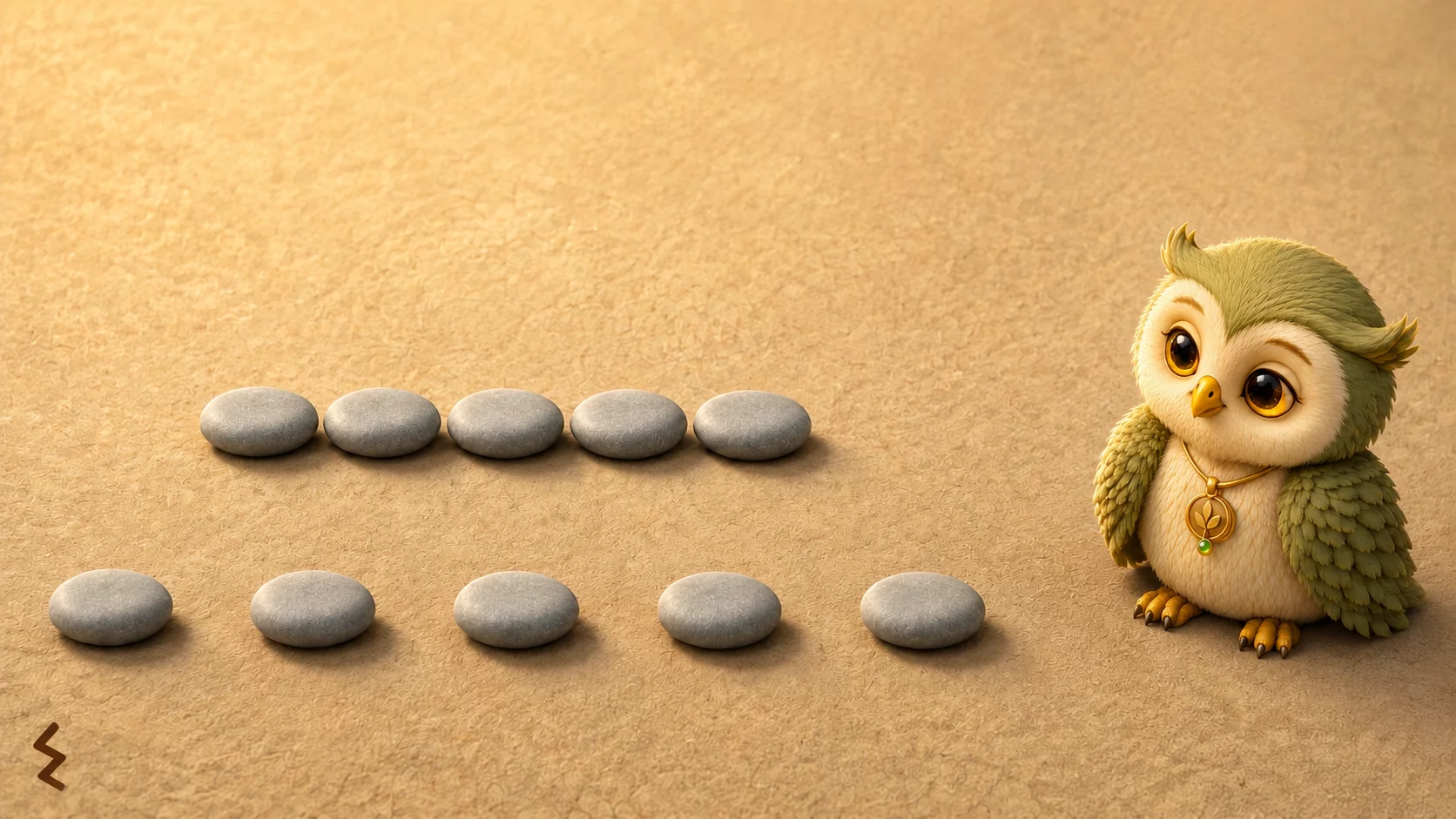
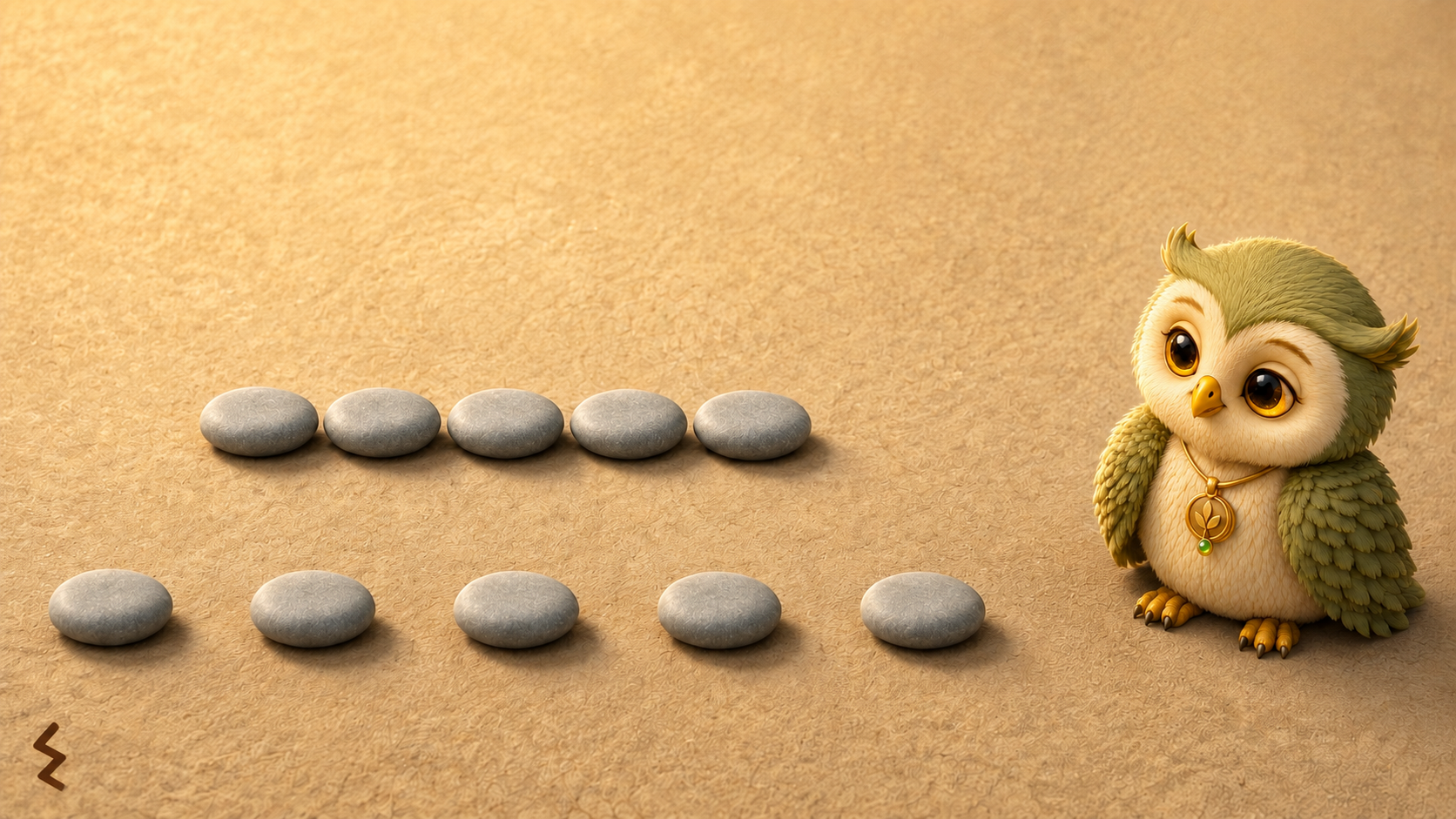
Put six buttons in two rows. Same number in each. Ask which row has more and your child says they’re the same.
Now slide one row apart so it stretches wider, without adding anything. Ask again. There’s a good chance she’ll point at the longer row and tell you, with total confidence, that it has more now.
She watched you do it. She isn’t guessing, and she isn’t being silly.
What she’s actually answering
For a young child, “more” and “takes up more space” are the same word for a while. The row that goes further looks like the row that has more, because for most of her life so far, bigger and more have arrived together.
This is a stage, not a gap. It shows up in children who count beautifully, which is what makes it so unsettling to watch. She can count both rows, say six twice, and still tell you the long one has more. Counting and comparing are two different jobs, and they don’t finish at the same time.
Comparing comes before counting, not after
Here’s the part that surprises most of us. Your child could answer “who has more” long before she could count anything. Two cookies against five, hers against her brother’s, and she knew instantly.
That means comparing isn’t the advanced version of counting. It’s the older skill, the one that was there first, and it’s worth working on directly instead of waiting for counting to unlock it.
Try this tonight
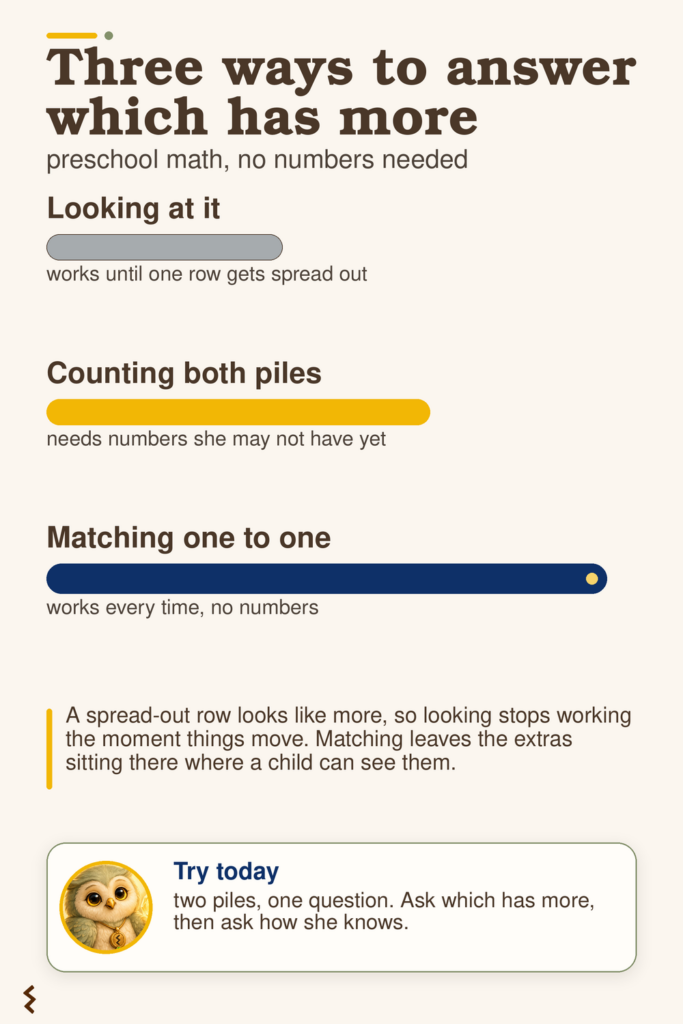
Give her two small piles of something and ask which has more. Then ask the question that does the work: how do you know?
If she says “because it’s longer,” don’t correct her. Instead, ask her to match them up, one from this pile next to one from that pile, and see what’s left over. Matching is the tool that survives when looking stops working, and it doesn’t need a single number.
Do it with cups and straws too. Will every cup get a straw? How can we check without counting?
The taller pile can have fewer
Once matching is comfortable, try the version that catches everyone out. Build a tall stack of four big blocks next to a low heap of seven small ones. Ask which has more.
Height is even more convincing than length, so expect the tall one to win at first. This isn’t a test she passes or fails. It’s a moment where looking and checking disagree, and noticing that disagreement is the whole skill.
The thing not to say
Don’t say “no, they’re the same, look.” She did look. That’s how she got her answer, and being told her eyes are wrong doesn’t give her anything to do instead.
Give her the matching instead and let the leftovers make the argument. Children accept an answer they produced far more readily than one they were handed.
The part worth remembering
If your child says the spread-out row has more, nothing has gone wrong. She’s answering a question about space with the tools she has, and the fix isn’t a correction, it’s a second way to check.
The same widening applies elsewhere. We wrote about why lining things up is math, and about what it means when a child writes numbers she doesn’t understand.
Free printable: Find the Acorns — four levels of searching and counting, one page each. Print the level that matches where your child actually is, not the one that matches her age.
No reading required · Prints clean in black and white · One task per page