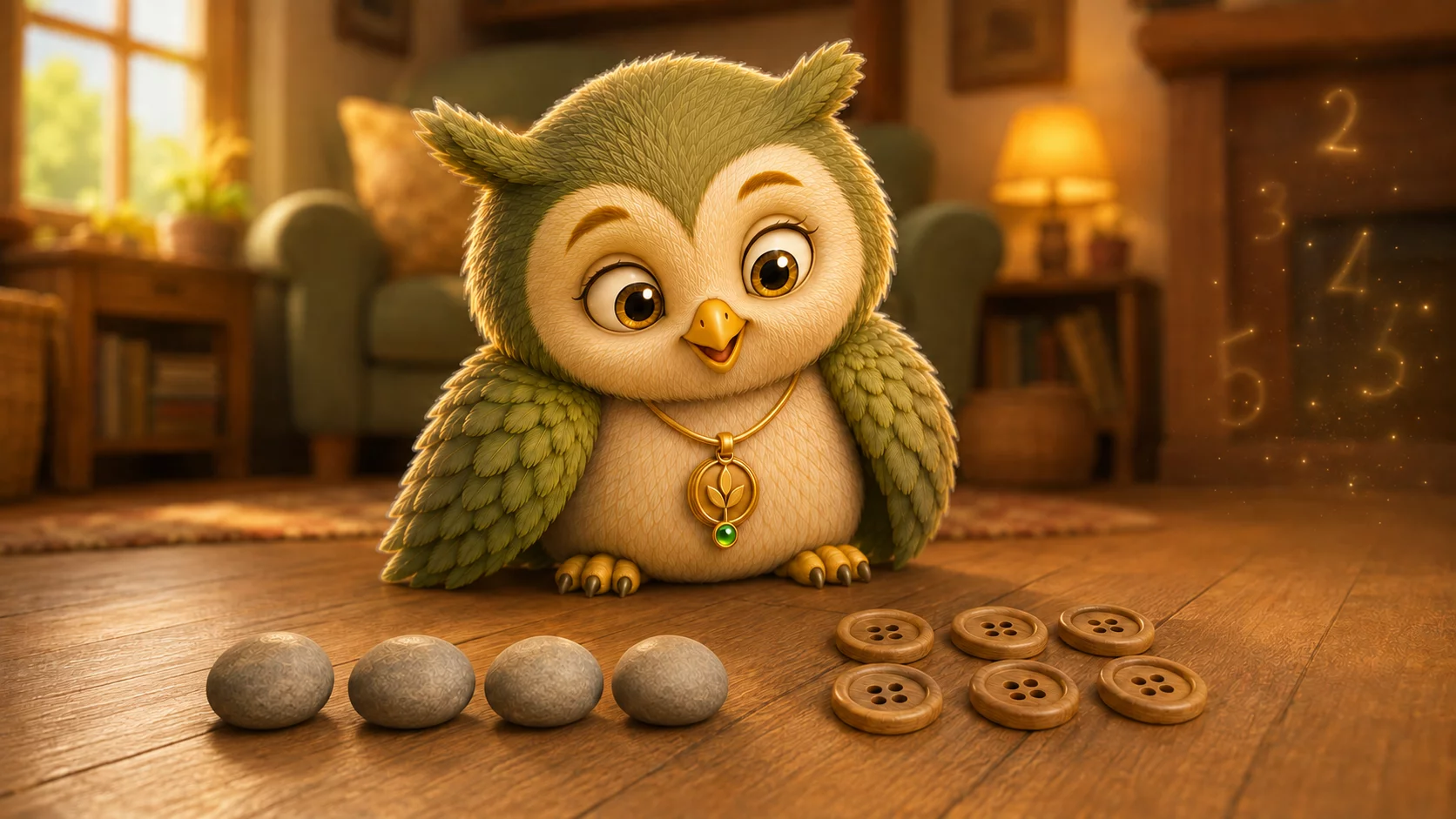
Put four large stones next to six small buttons and ask a four-year-old which group has more. Most will point at the stones. They are not guessing. They are answering the question they heard, which is closer to which one is bigger, and the stones win that one easily.
Many four-year-olds do this. It fades on its own as counting gets steadier. It is worth recognizing, because it makes a child who can count to twenty look like a child who cannot count at all.
What is my child actually comparing?
Size, or the amount of space a group takes up. Six pennies spread across the table look like more than eight pennies pushed together, and to a young child they are more, because longer is the measure she trusts. You can watch this happen in about ten seconds.
Lay out two rows with the same number of coins in each. Spread one row wide, push the other one together. Ask which row has more. Then slide the spread row back into a tight line and ask again. A lot of four-year-olds change their answer.
Is something wrong?
No. Saying the number words in order and knowing what the last word stands for are two separate jobs, and the second one takes longer to arrive. A child who compares by size is using the tool she has. The counting tool shows up later and then takes over.
What can I do instead of correcting her?
Let her check it herself. Telling her the answer settles this one question and teaches her that you already knew, which turns the next question into a test. One thing that helps: ask how you could both find out, then stop talking. The silence is the activity.
How do we find out without counting?
Pair the two groups off. One stone, one button. One stone, one button. Whatever is left over at the end belongs to the group that has more. Nobody had to count, and nobody had to take your word for it, which is the part that matters when your child does not believe your answer.
This works with anything already out on the floor: snacks, socks, blocks, toy cars.
How will I know it is shifting?
She counts both groups without being asked, and she believes the count over what her eyes told her a second earlier. That second half is the slow part, and it is one of the things worth watching for long before she can add anything.
When she gets it, make it harder
Same number on both sides, different object sizes. Four big blocks, four small ones. Now the honest answer is they are the same, and that is a harder answer for a child to give than picking a winner.
What to say
- Which side has more? Ask it like you do not know.
- How could we find out? Then wait, even when the waiting feels long.
- Let’s line them up. One to one, and the leftovers answer it.
- You were right about the big ones being big. She was. It was a different question.
Free printable: Bigger or More? Two piles, one question, and nothing to write. Four cards, one per level, ages 2.5 to 7.
One card is a direct download, no email. The full four-level set comes by email.
No reading required · US Letter · Prints clean in black and white · One task per page