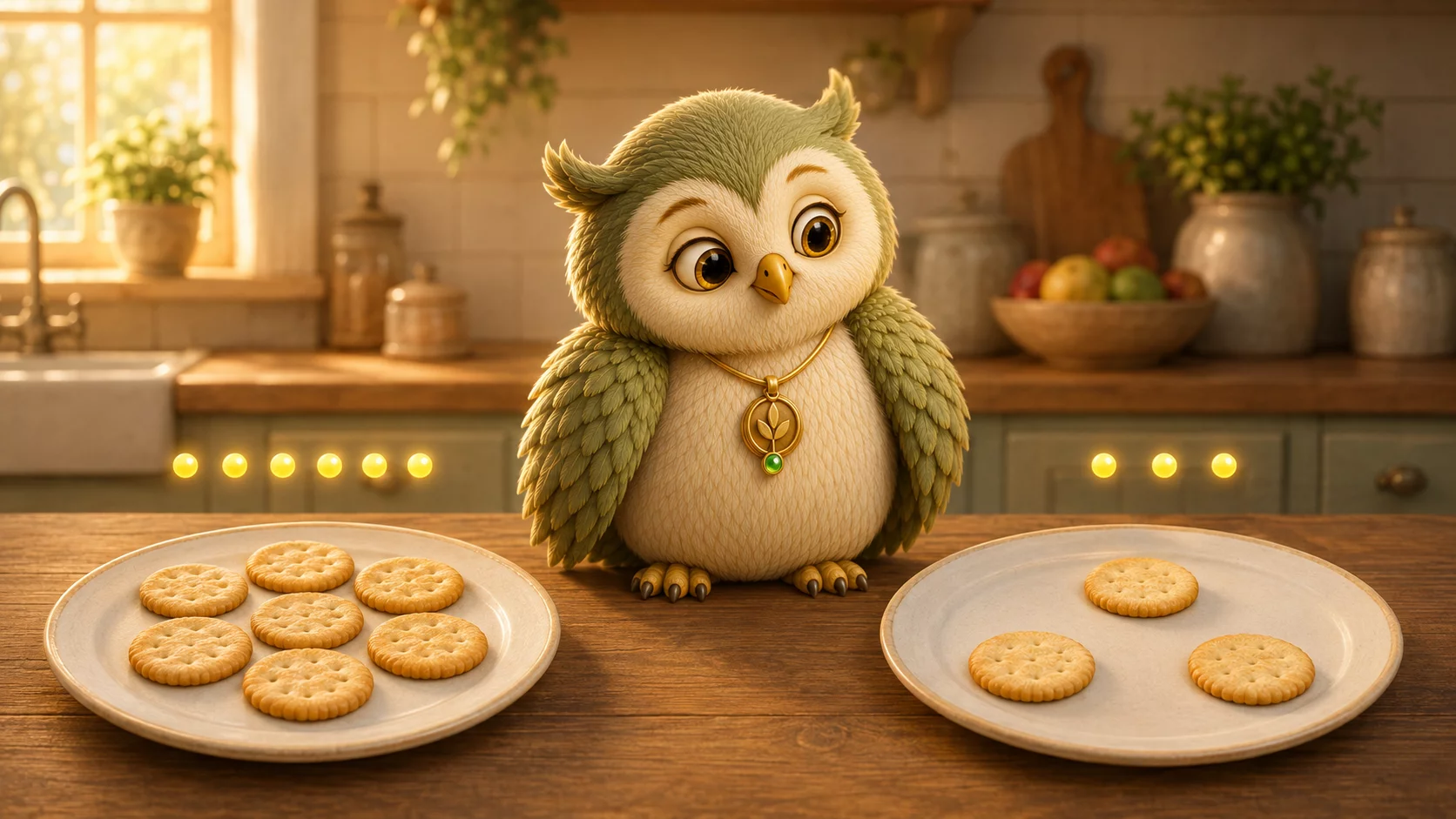
If your child can’t count reliably yet, you don’t have to wait to do math with them. Put a handful of something on two plates and ask which one has more. That question is math, and most kids can answer it before they can count to ten.
Here’s how to run it, and what to do when the answer is wrong.
What do you need for this?
Two plates, bowls, or napkins. Then about fifteen of one small thing: berries, crackers, blocks, buttons, cereal.
Snack time is the easiest place to do this, because the objects are already out and nobody has to be recruited.
- Ages: 3 to 5
- Skill: comparing two amounts and saying how you know
- Time: five minutes, no prep
- Cost: nothing, and no printer needed
How do you actually run it?
Put a few pieces on each plate and make one plate clearly fuller. Six and three is a good start.
Say: “Which one has more?”
Then ask the second question. This is the one that matters.
Say: “How do you know?”
Now try a close pair, five and four. Harder, and worth doing.
Last, take the plate with fewer pieces and slide them apart so they cover more space. Ask again.
Say: “What about now?”
What do you say when the answer is wrong?
Don’t correct it. Check it together.
Say: “Let’s find out. One for you, one for me.”
Line the two groups up side by side, one piece from each plate at a time, until one group runs out. The leftover is the answer, and your child can see it without counting anything.
Say: “Look, these ran out and these didn’t.”
Why does spreading the pile out change the answer?
Two things are going on here.
The first is language. Words like more, fewer, the same, and how many are the words a child needs before numbers mean much. Researchers led by Purpura found that preschoolers’ math-specific vocabulary lined up with how they did on early math tasks. That’s a relationship they measured, not proof that teaching the words causes the skill, and I’d rather say that plainly than oversell it.
The second is the spreading. Young children very often say the spread-out group has more, because it takes up more space. That isn’t a mistake in the ordinary sense. It’s a well-documented stage that most kids pass through, described in Clements and Sarama’s work on how early math develops. It’s the same reason a taller stack looks like more to a four-year-old.
So when your child confidently tells you the spread-out row has more, nothing is wrong. You’ve just watched them think.
How do you make it easier or harder?
Easier: use a big difference, seven on one plate and two on the other, and skip the spreading step for now. Keep the same object on both plates. Comparing three grapes to three crackers adds a problem that isn’t the one you’re working on.
Harder: make the two amounts equal and see whether your child says so. Say: “The same, not more and not less.”
Then try three plates. Which has the most? Which has the fewest? Ordering three groups is a real step up from comparing two. The signal your child is ready: they line the groups up on their own to check, without being told.
What if it doesn’t go well?
- They eat the math. Expected outcome with berries. Use blocks, or accept it and compare what’s left.
- They answer without looking. Slow the setup down. Build each plate in front of them, out loud, then ask.
- They insist the spread-out row has more, even after you check. Leave it. Say “huh, interesting” and come back in a couple of weeks. This one resolves with time, not with explanation.
- A sibling shouts the answer. Give the older one the job of setting up the plates instead of answering.
What comes after this?
When comparing two groups feels easy, move to estimating. Hand your child a small pile, ask them to guess how many before you count it together, then compare: was the guess high or low? There’s no wrong first guess.
This also pairs well with changing the question you ask at the table, because both moves shift the work from reciting to noticing.
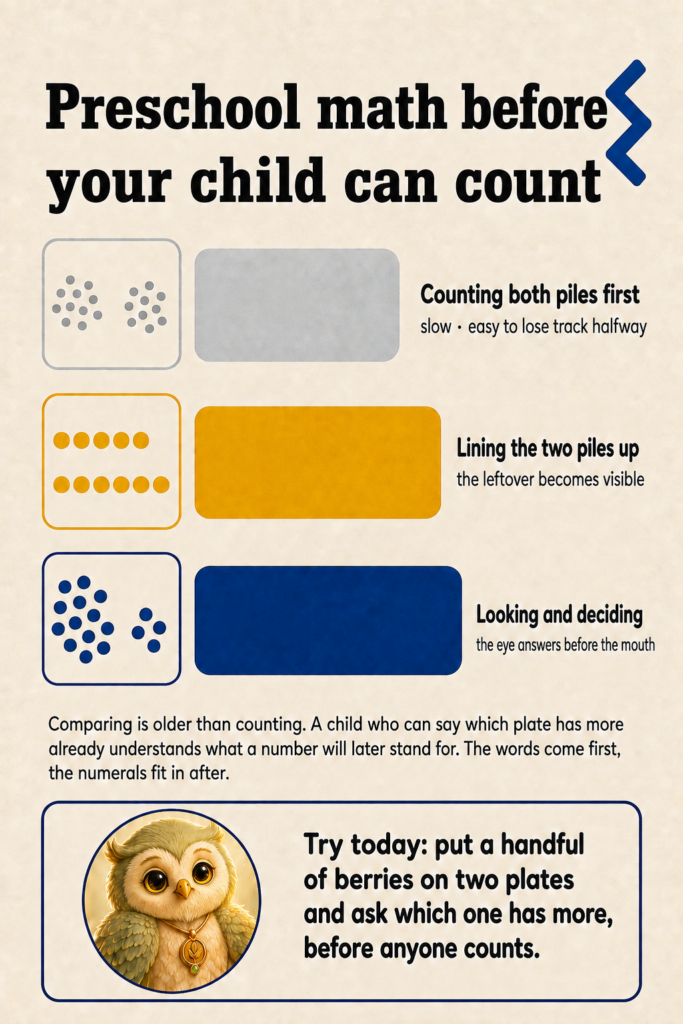
Free printable: Count and Compare — two groups on a page and one question. Your child decides which side has more, then checks by pairing them up.
Four levels in the set · One card downloads right away, no email · Prints clean in black and white