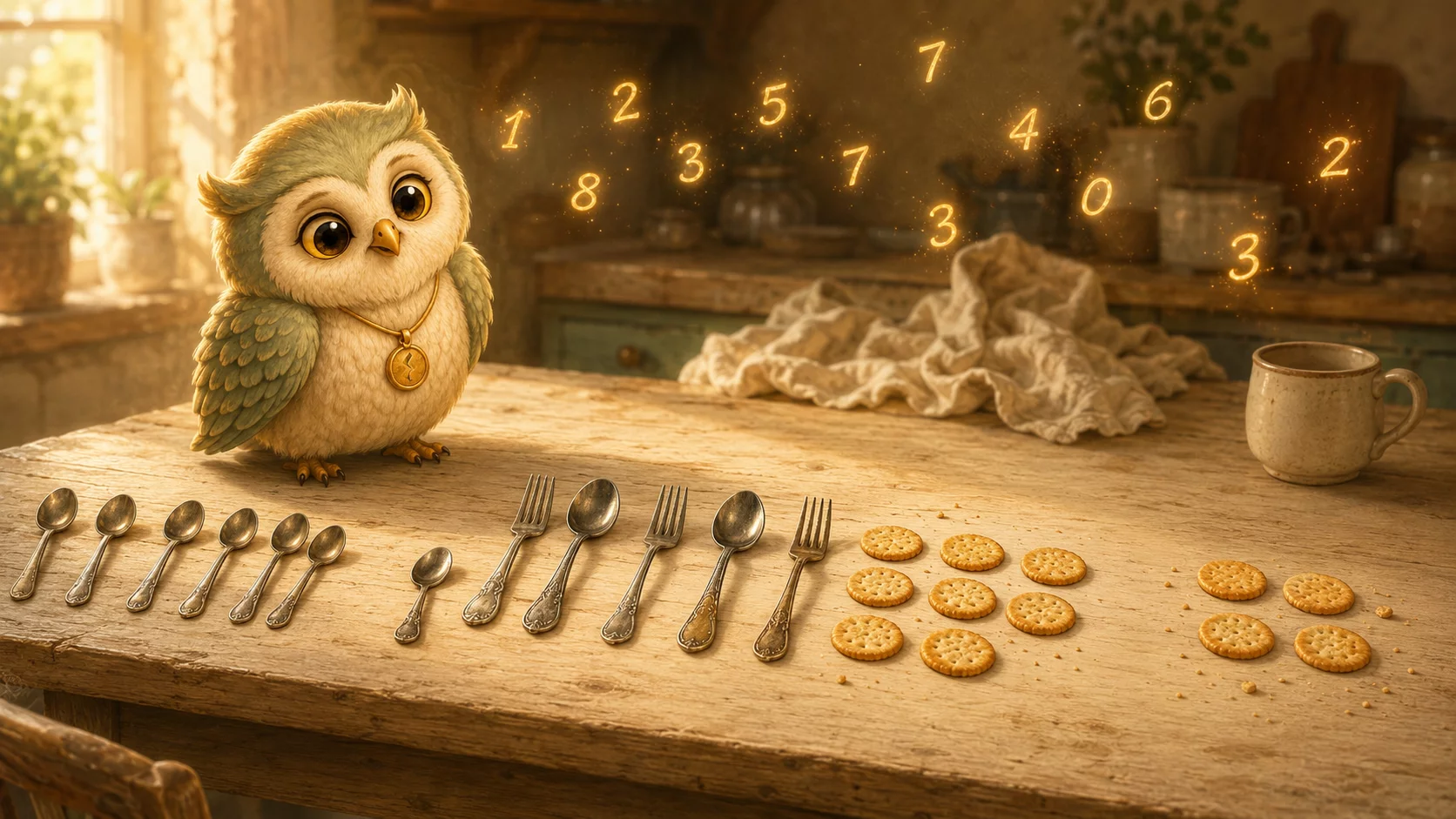
It is the second week of August, the school supply list is on the counter, and someone at the playground just asked whether your five-year-old can count to a hundred yet.
So you go home and you try it. She gets to twenty-nine, says “twenty-ten,” laughs, and runs off.
Nothing is wrong. But the number she stopped at told you almost nothing, and that is worth knowing before you spend three weeks drilling the wrong thing.
Every checklist tests the same corner
Search for a kindergarten readiness checklist and you will find a dozen of them. Count to 20. Recognize numerals 1 through 10. Count objects in a group.
They are not wrong. They are all asking about the same corner of math, and it happens to be the corner that is easiest to test and easiest to drill.
Reciting numbers is a memory skill. A child who has memorized the sequence looks identical, on paper, to a child who understands what the numbers mean. The checklist cannot tell them apart.
The things checklists skip are easy to see at home, and they take about five minutes.
One: after the counting, ask again
Put out six spoons. Ask her to count them. She points and says one, two, three, four, five, six. Now ask: “So how many spoons are there?”
Some children answer “six” without hesitating. Others start counting again from the beginning — and that is the moment worth noticing. It means the counting was a song, not an answer. The last number she said has not yet become the size of the group.
This is not something to correct on the spot. It arrives on its own, usually somewhere between four and six, and it arrives sooner for children who get asked the question.
Two: two piles, and no counting
Put four crackers in front of you and seven in front of her. Ask: “Who has more?”
Do not let her count. She does not need to. Comparing quantity by eye comes before arithmetic and underneath it, and it is what she will lean on later when she has to decide whether an answer is even reasonable — which is why “how many” is often the wrong first question.
Then make it harder in the useful way: four big crackers against seven small ones. If she says the big pile has more, she is answering a question about size, not number. That is normal, and it is exactly the confusion that comparing practice resolves.
Three: start a pattern, then stop
Fork, spoon, fork, spoon, fork — and then stop and look at her.
You are not asking her to name the pattern. You are watching whether she reaches for the spoon. Noticing that something repeats, and using it to predict what has not happened yet, is the shape of most of the math that comes after.
If she puts down a fork, do not fix it. Say “hmm, let’s see,” and lay the row out again from the start. Children read patterns by watching them repeat, not by being told the rule.
Four: a direction with no pointing
Hands behind your back. “Can you put the cup behind the bowl?” Then: “Now put it between the bowl and the plate.”
Behind, between, next to, under, above. This is spatial language, and it is math even though it contains no numbers. It is how she will later hold a shape in her head and turn it, or read a number line.
It is also the easiest of the four to build, because it costs nothing but the words you were going to say anyway. “Pass me the one behind the milk” instead of “pass me that one.”
What to do with what you saw
Probably nothing dramatic. That is the honest answer.
If two or three of those four went sideways, she is a normal five-year-old with a normal amount of growing left to do. Kindergarten teachers expect that. What they cannot do is have this conversation with her forty times a week the way you can over breakfast.
The everyday version is the version that seems to matter. A 2024 meta-analysis pooling almost 36,000 children found that families who talk about numbers and quantities in ordinary moments have children with stronger early math. That is a correlation, not proof that the talking causes the gain — but it points at the kitchen, not the workbook.
Which is a relief, because you have three weeks and a supply list, not a curriculum.
Where this goes
Three of those four questions were not about counting at all. That is not an accident — comparing, patterns and spatial language each open into their own part of early math, and none of them appear on a readiness list.
Patterns are the one most parents have never heard framed as math. That is the next post.
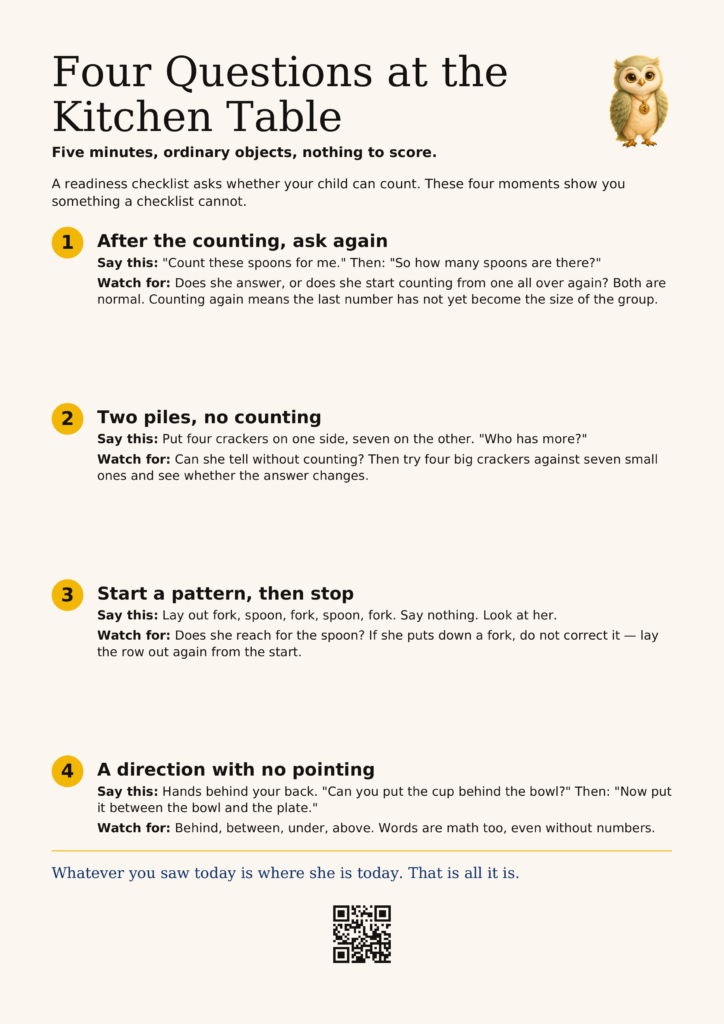
Free printable: Four Questions at the Kitchen Table — all four of these on one page, with what to say and what to watch for after you say it. Stick it on the fridge and try one while dinner is cooking.
One page · Prints clean in black and white · Nothing to score