She can count to ten. You put three carrots on the plate, ask how many, and she says fourteen.
If you’ve watched that happen, you’ve already seen the gap this article is about. It isn’t a problem with counting, and it isn’t a sign that anything went wrong. It’s a second skill sitting right next to counting, and most of us never hear it named.
What the guessing actually means
There are three different things happening when a young child deals with numbers, and they arrive in order, months apart.
The first is reciting. One, two, three, four. It’s a song with words instead of la-la-la, and children get good at it early because songs are easy to learn.
The second is counting things. Touching each carrot once, saying one number per carrot, and stopping. That’s harder than it sounds, and it’s where most of the practice at this age goes.
The third is seeing how many without counting at all. You do this constantly. When two socks fall out of the laundry, you don’t count them. You look and you know. Children build that too, starting with very small amounts, and it’s the one almost nobody practices on purpose.
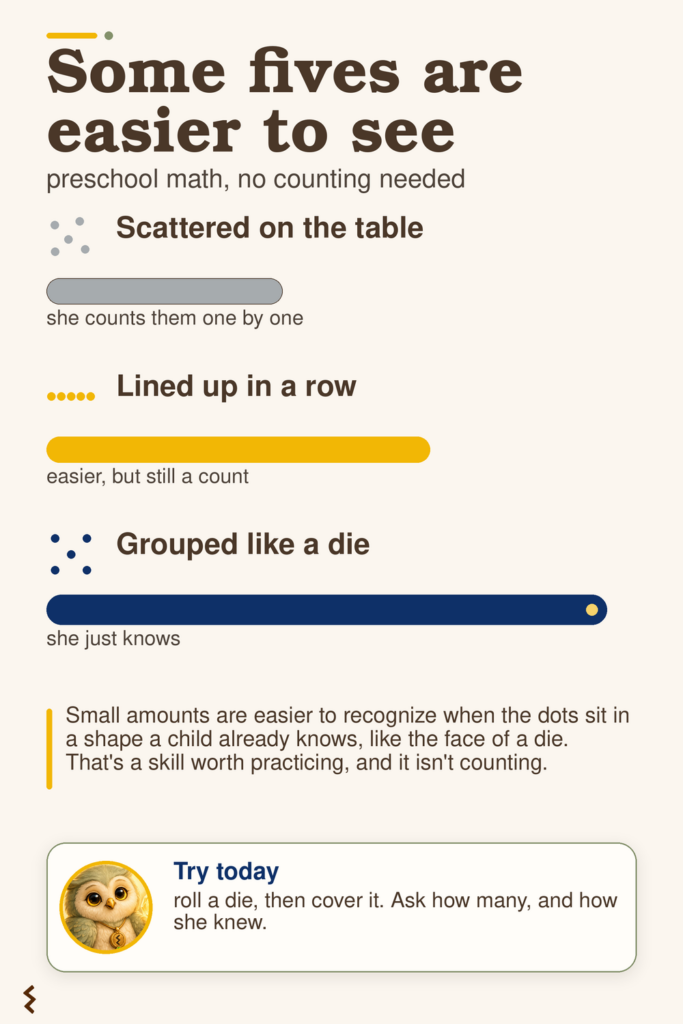
Some fives are easier to see than others
Here’s the part that surprised me when I first started paying attention to it. Whether a child can see an amount without counting depends less on the amount than on how it’s arranged.
Put five buttons in a loose pile on the table and most four-year-olds will count them one at a time, and some will lose track halfway. Put the same five buttons in a straight row and it gets easier. Put them in the shape you’d see on the five side of a die, four corners and one in the middle, and something different happens. Children who’ve seen that shape before don’t count it. They recognize it, the way you recognize a face.
Same five buttons. Three completely different tasks for your child.
Try this tonight, in about two minutes
Find one die. A board game in the closet has one, and if it doesn’t, five buttons will do.
Roll it, let your child look for a second or two, then cover it with your hand. Ask how many. Then ask the question that matters more: how did you know?
The second question is the whole exercise. “I counted them” and “I just saw it” are two different answers, and hearing which one comes out tells you more about where your child actually is than a worksheet would. It also gives her the words for something she’s been doing without noticing.
Do it three or four times and stop while it’s still fun. This isn’t a session. It’s the length of time it takes you to clear one plate.
Three ways to keep it going this week
- Use shapes she already knows. Dice faces, domino halves, the dots on a playing card. Familiar arrangements are recognized fastest, and a shape she’s seen a hundred times is doing half the work for her.
- Keep the objects plain. Buttons, bottle caps, identical coins. When the things being counted are exciting on their own, attention goes to the object instead of the amount, and the whole point of the game leaks away.
- Say what you notice out loud. “There are four forks and there are four of us.” “Two rows of three.” You’re not quizzing her. You’re letting her hear that amounts are a thing worth mentioning.
The one thing not to say
Don’t say “count the dots.”
It’s the most natural sentence in the world and it undoes the exercise. The whole idea is to look instead of count, so an instruction to count teaches the opposite habit and turns a two-second game back into the thing she already does.
For the same reason, cover the die quickly. If it stays visible, she has time to count it, and she will, because counting is what she’s been praised for so far.
When this isn’t the place to start
If your child still touches some objects twice and skips others while counting a small group, that’s the skill to sit with first. Seeing an amount at a glance builds on top of one thing at a time, not instead of it.
You’ll know within one round. Give her four buttons in a row and watch her fingers, not her mouth. If each button gets touched once, you’re both ready for this. If they don’t, spend a week on what counting to twenty actually tells you and come back to the die after that.
The part worth remembering
Counting out loud is the visible skill, so it’s the one that gets practiced, praised and worried about. Recognizing an amount without counting is quieter, it shows up in ordinary moments, and it’s just as much a part of early math.
Your child is probably doing it already with two and three. A die and one extra question is enough to build it from there. And if the writing side is what’s on your mind, that’s a separate skill again, and we wrote about it in what it means when a child writes numbers she doesn’t understand.
Free printable: Find the Acorns — four levels of searching and counting, one page each. Print the level that matches where your child actually is, not the one that matches her age.
No reading required · Prints clean in black and white · One task per page