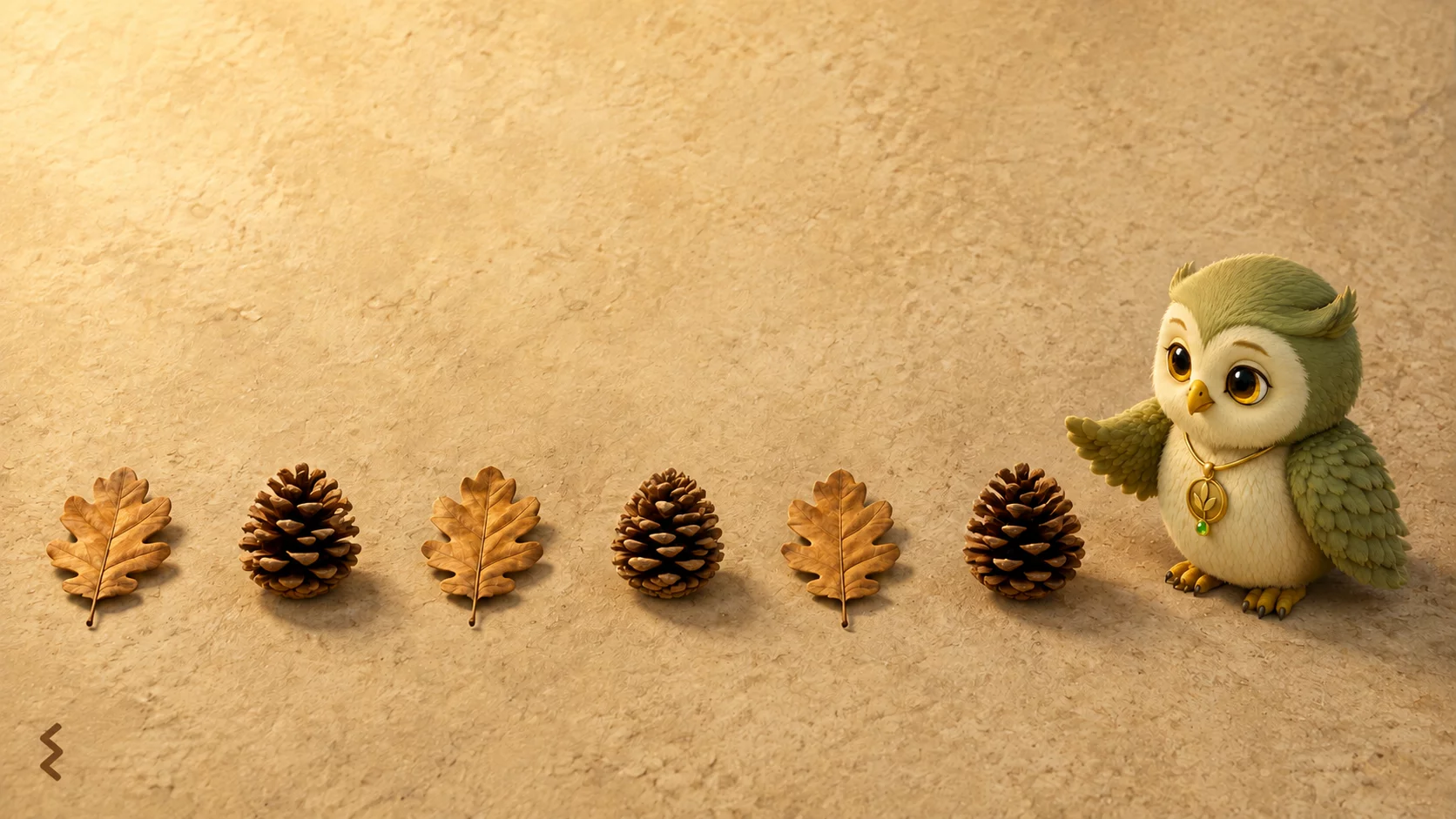
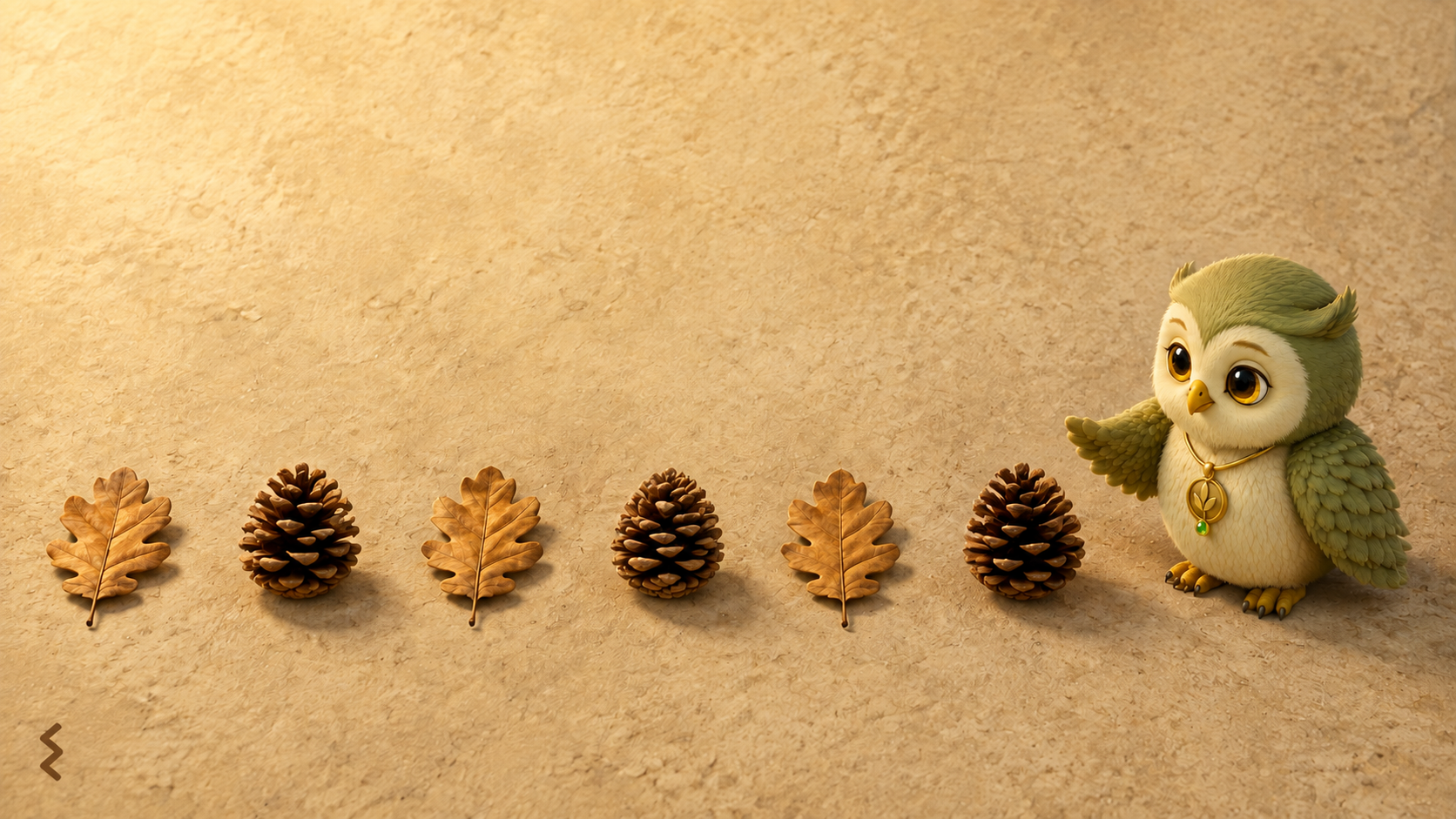
Your child lines up the cars by color. Blue, red, blue, red, all the way across the rug, and then gets annoyed when you move one.
Most of us file that under tidying, or under a quirk. It’s math, and it’s one of the few kinds of math a three-year-old can do properly, on her own, with no help from us at all.
What a pattern actually is
A pattern is a rule you can use to say what comes next. That’s the whole definition, and it’s the reason patterns belong in a math conversation instead of an art one.
When your child says the next car should be blue, she isn’t remembering. She’s reading a rule off the row in front of her and using it to predict something she can’t see yet. That’s the same move she’ll make later with much harder material, and she’s making it now with toy cars.
Counting gets almost all of our attention at this age because it’s loud and easy to check. Patterns are quiet. Nobody claps when a child continues a row.
Start at the table, not with a worksheet
While you’re setting dinner, lay out spoon, fork, spoon, fork along the edge of the table. Then stop, look at your child, and ask what comes next.
Ask for two more, not one. One can be a lucky guess. Two in a row means she’s using the rule.
That’s it. No printing, no buying, no sitting her down. The kitchen is full of things that come in two kinds, and so is the yard, and so is the laundry basket.
When she gets it, break it on purpose
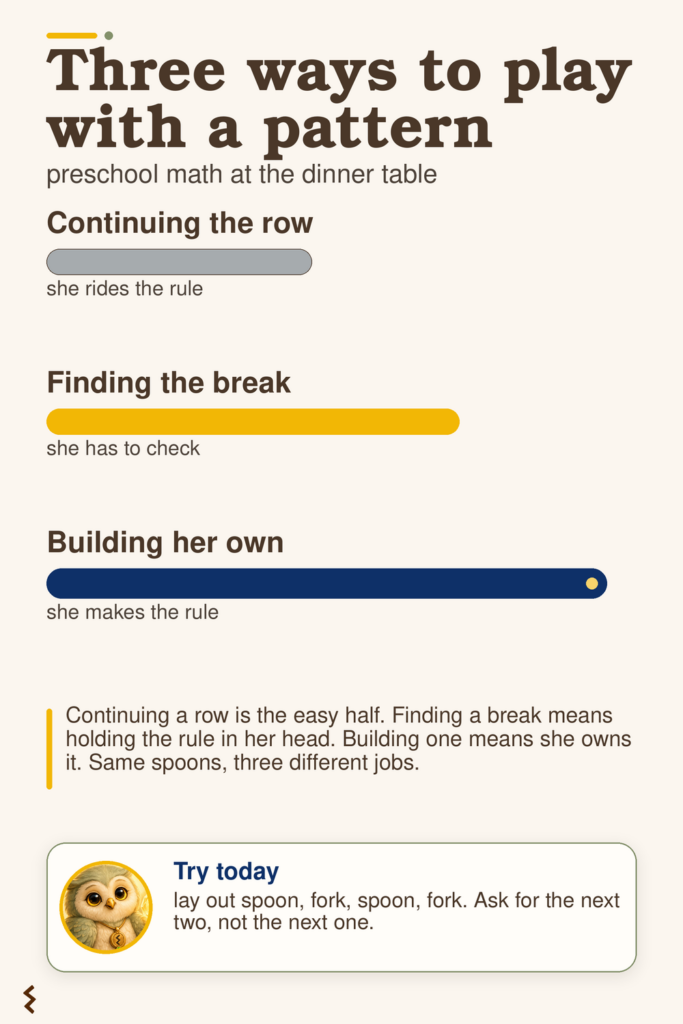
Once continuing the row is easy, do something better than making the row longer. Build spoon, fork, spoon, spoon, fork, and ask her to find the part that’s wrong.
Spotting a break is harder than continuing, because she has to hold the rule in her head and check the row against it instead of just riding along. Children who find this funny will find it very funny, and you’ll get asked to do it again.
The step after that is letting her build one and asking you to continue it. Get it wrong once on purpose. You’ll hear about it.
Then change the shape of the rule
Almost every pattern a young child meets goes one, other, one, other. Try spoon, spoon, fork, spoon, spoon, fork instead.
This one throws children who breezed through the simple version, and that’s the point. It means the rule isn’t a habit yet, it’s something she has to actually look for. Give it a few tries across a week rather than a few tries in one sitting.
The thing not to say
Don’t tell her the rule out loud before she looks for it. “It goes spoon, fork, spoon, fork, so what’s next?” turns a puzzle into an instruction, and she’ll answer correctly without ever doing the part that mattered.
Point at the row and wait. Waiting feels much longer than it is.
The part worth remembering
Early math is wider than counting, and patterns are the part most of us walk past because it doesn’t look like school. If your child arranges things and gets cross when you disturb the arrangement, she’s already started.
If you want the other half of what gets missed at this age, we wrote about seeing an amount without counting it. And if the counting itself is what’s on your mind, start with what counting to twenty actually tells you.
Free printable: Find the Acorns — four levels of searching and counting, one page each. Print the level that matches where your child actually is, not the one that matches her age.
No reading required · Prints clean in black and white · One task per page