Your child has three acorns. You hand them two more and ask how many. They go back to the first acorn and start again: one, two, three, four, five.
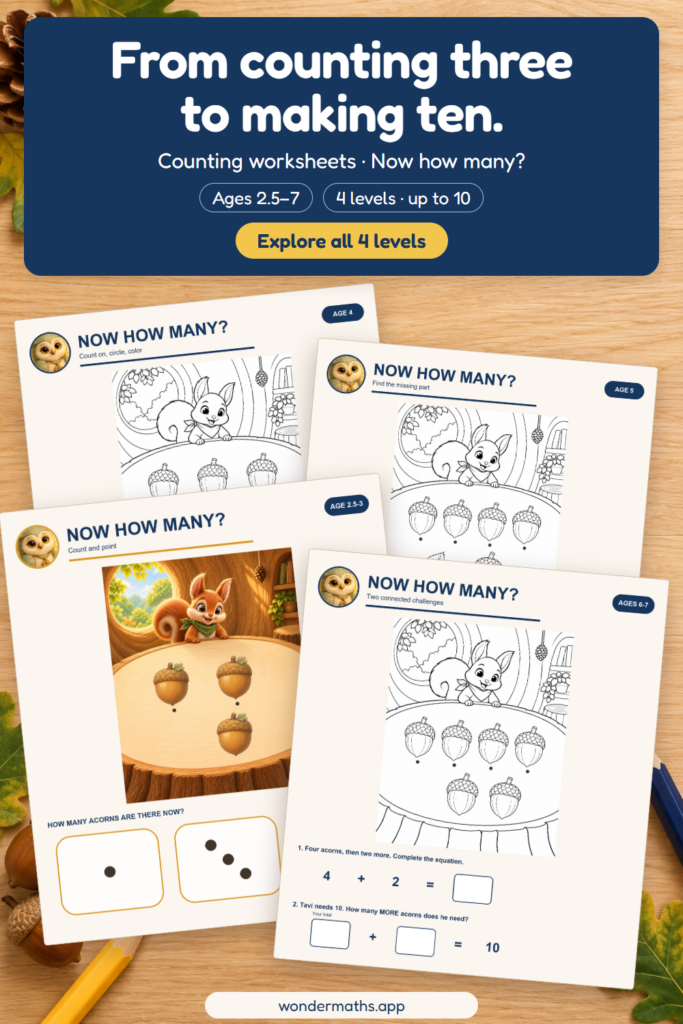
That’s not a mistake. It’s the stage before counting on, which is when a child holds the three in their head and says “four, five” from there. The Now How Many? set is built around that one shift. Four levels, one squirrel, one pile of acorns that keeps getting bigger.
Why is starting over so common?
Because for a young child, the word “three” is often the end of a chant, not a quantity they can pick up and carry. If “three” doesn’t yet mean “this many, right here,” there’s nothing to count on from. So they rebuild it every time.
This is the same reason a child can recite to twenty and still miscount five things. Counting on shows up when the number starts to mean the amount. You can’t rush it, but you can give it lots of chances to happen.
What does each level ask the child to do?
- Age 2.5 to 3, full color: three acorns on a stump. Count and point. Then choose the dot card that shows how many. No numerals yet, just dots the child can match to acorns.
- Age 4, outlines to color: a row of acorns, then a few more join. The child counts on from the ones already there, circles the total, and colors. The instruction is “count on,” and the parent line at the bottom tells you how to model it.
- Age 5: find the missing part. Some acorns are there, the total is known, and the child works out how many are hidden. This is counting on in reverse, and it’s the first quiet step toward subtraction.
- Age 6 to 7, two connected challenges: four acorns, then two more, written as 4 + 2 = ___. Then: Tavi needs ten, so how many more? The second question uses the answer from the first. That’s the point of the pair.
How do I model counting on without teaching a trick?
Put your hand over the first group and say its number out loud. “Three.” Then touch the new ones one at a time: “four, five.” Do it a few times over a few days. Don’t ask them to do it yet. Kids usually copy the move before they understand it, and that’s fine. The understanding tends to catch up.
If they keep going back to one, let them. Then say the total together. “Five. There are five.” You’re showing that the count ends somewhere and the ending is the answer.
Which level should I print?
The one where your child gets about seven or eight out of ten on their own. If it’s ten out of ten, go up. If it’s a fight, go down a level for a week and come back. The age label is for finding the set, not for judging the child.
If your child is already comfortable with 4 + 2, you might like how we start adding with acorns instead of plus signs. Same squirrel, same idea, one step further.
Now How Many? is one acorn task in four levels: count three, count on from a group, find the missing part, and make ten with two connected questions.
No reading required · Prints clean in black and white · US Letter, print at 100% · Age 4 page opens right away, full set by email