Before a child can understand that three comes after two, something simpler has to click: anything comes after anything. First, then, last. That’s the whole idea, and it’s older than counting.
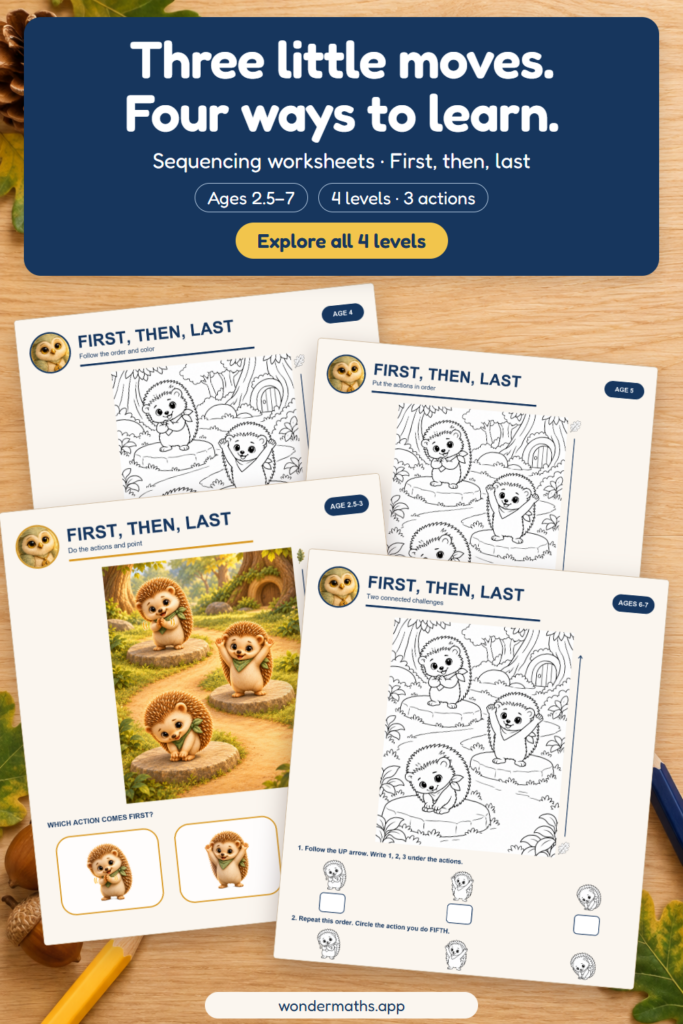
The First, Then, Last set uses three hedgehogs doing three little moves on stepping stones: crouch, reach up, hop. Same three moves on every page. What changes is what the child does with the order.
Why is order math?
Because numbers are an order before they’re amounts. “Two” is the thing between one and three. A child who can put three actions in sequence and hold that sequence while doing something else has the mental habit that number lines, clocks, and calendars all rely on later.
It also shows up in the little things teachers watch for in kindergarten: following two- and three-step directions, telling what happened first, waiting for a turn. None of that involves numerals, and all of it involves sequence.
What does each level ask the child to do?
- Age 2.5 to 3, full color: do the actions and point. The child copies the three moves with their body, then points to the one that came first. This level is meant to be done standing up.
- Age 4, outlines to color: follow the order and color. The three hedgehogs are on the page in sequence, and the child colors them in the order the moves happen. Coloring in order is harder than it sounds, because the child wants to start with the one they like best.
- Age 5: put the actions in order. The moves are scrambled, and the child has to arrange them: first, then, last. This is where the words start to carry the sequence instead of the body.
- Age 6 to 7, two connected challenges: follow the arrow and write 1, 2, 3 under the moves. Then: repeat this order and circle the move you do fifth. The second question only works if the child can run the sequence twice in their head. That’s the first taste of a repeating cycle.
What if they can do it with their body but not on paper?
Then they’re on the right track, and the paper is just early. Do the moves together a few times. Say the words while you move: “first crouch, then reach, last hop.” Then look at the page and ask which hedgehog is doing the first one. The body knows the order before the eyes do.
This is also why the youngest level asks for pointing, not coloring. A child who can’t hold a crayon yet can still hold a sequence.
Which level should I print?
The one where your child gets about seven or eight out of ten on their own. Age labels help you find the set. They don’t decide for you. If the numbered page is a struggle, the arranging page for a week usually does more good than more numbered pages.
If three moves at the table becomes a routine your child asks for, it fits neatly into a fifteen-minute evening rhythm without adding anything new.
First, Then, Last is three little moves in four levels: do them, color them in order, arrange them, then number them and find the fifth step in a repeating cycle.
No reading required · Prints clean in black and white · US Letter, print at 100% · Age 4 page opens right away, full set by email