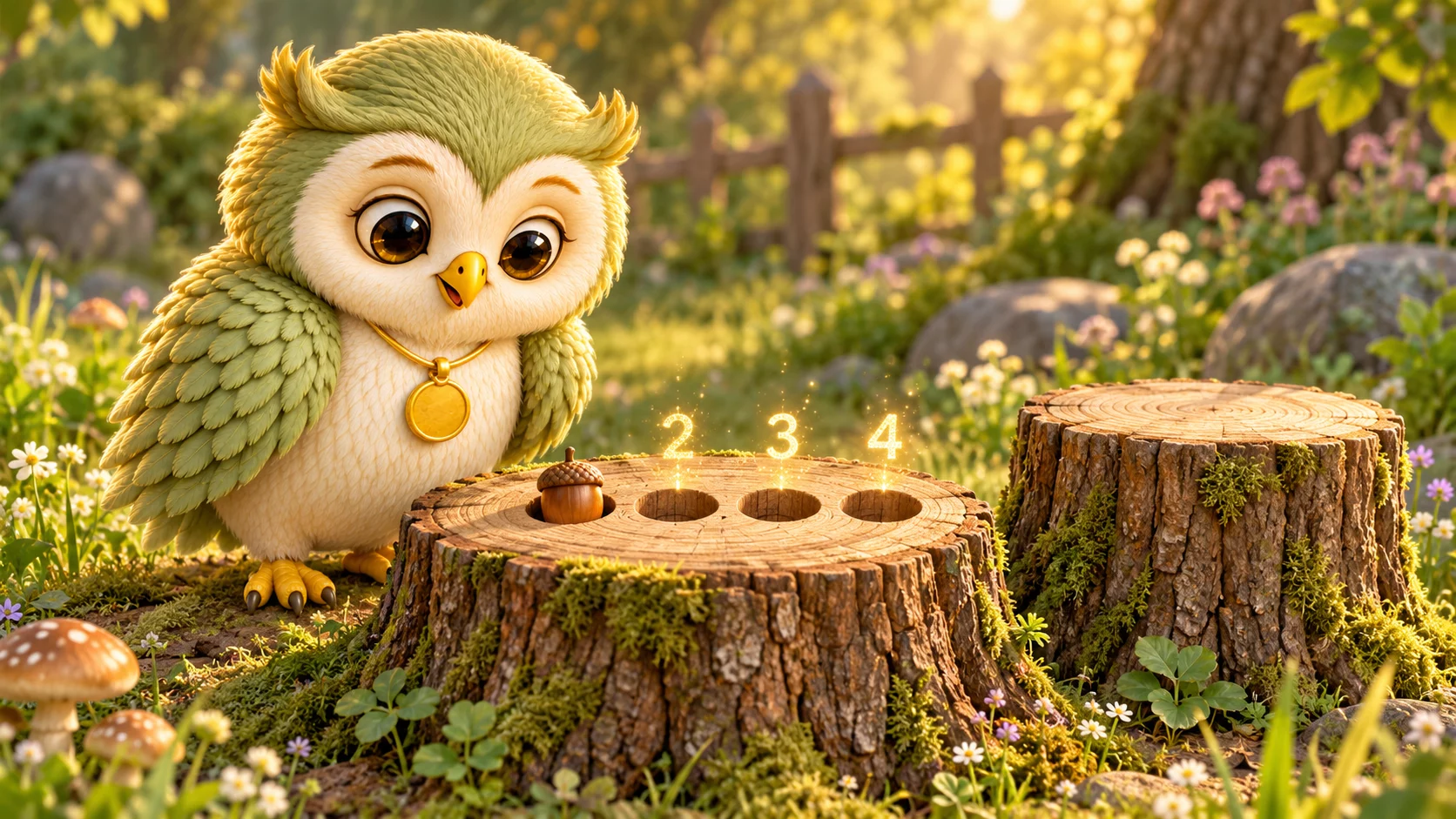
A child who puts acorns into holes and sees that one acorn is left over has just subtracted. They don’t know it’s subtraction. They don’t need to.
The How Much Fits? set is built on that kind of noticing. Two tree stumps, each with a few acorn-sized places. Four levels that go from counting the places to writing 3 + 3 and 8 minus 6, without the symbols ever arriving before the idea.
Why start with spaces instead of numbers?
Because “how many fit” is a question a child can check with their hands. If there are three holes and four acorns, something’s left out, and that’s visible. The number sentence comes later as a way of writing down what they already saw.
This is the same reason we start adding with acorns, not with plus signs. The plus sign is a summary. It only means something once the child has done the thing it summarizes.
What does each level ask the child to do?
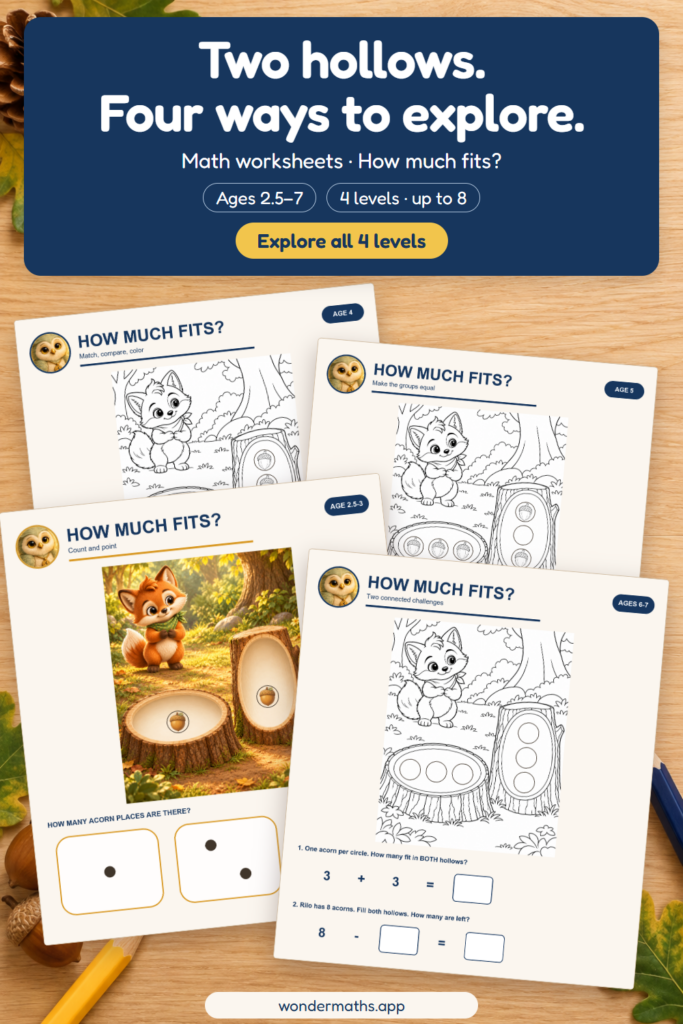
- Age 2.5 to 3, full color: two stumps, one acorn place in each. How many acorn places are there? Count and point, then pick the matching dot card. Two is a good number to start with, because the child can see both at once.
- Age 4, outlines to color: match, compare, color. One stump has three places, the other has two. The child colors an acorn into each place and notices which stump takes more.
- Age 5: make the groups equal. One stump has more acorns than the other. What has to move so they match? This is sharing, and it’s also the first step toward “how many more.”
- Age 6 to 7, two connected challenges: one acorn per circle, so how many fit in both hollows? Written as 3 + 3 = ___. Then: Rilo has eight acorns and fills both hollows, so how many are left? Written as 8 minus ___ = ___. The second one only works if the first answer is right, which is the point.
What if they count the acorns but not the empty places?
That’s a common stop. Empty spaces are harder to count than things, because there’s nothing to touch. Try putting a finger in each hole and saying the number as you go. The hole becomes a thing. Once the child copies that, the counting usually follows.
If your child is more interested in which stump has more than in exact counts, that’s fine. Comparing comes first for a lot of kids, and this set has a page for that.
Which level should I print?
The one where your child gets about seven or eight out of ten tries on their own. If they breeze through it, go up. If it turns into a fight, go down a level for a week. The age on the page is a label for finding the set, not a deadline.
And if the paper stalls, an egg carton and a handful of dried beans do the same job on the kitchen floor. The idea is the holes, not the worksheet.
How Much Fits? is one two-hollow task in four levels: count the places, match and compare, make the groups equal, then 3 + 3 and 8 minus 6 as two connected questions.
No reading required · Prints clean in black and white · US Letter, print at 100% · Age 4 page opens right away, full set by email