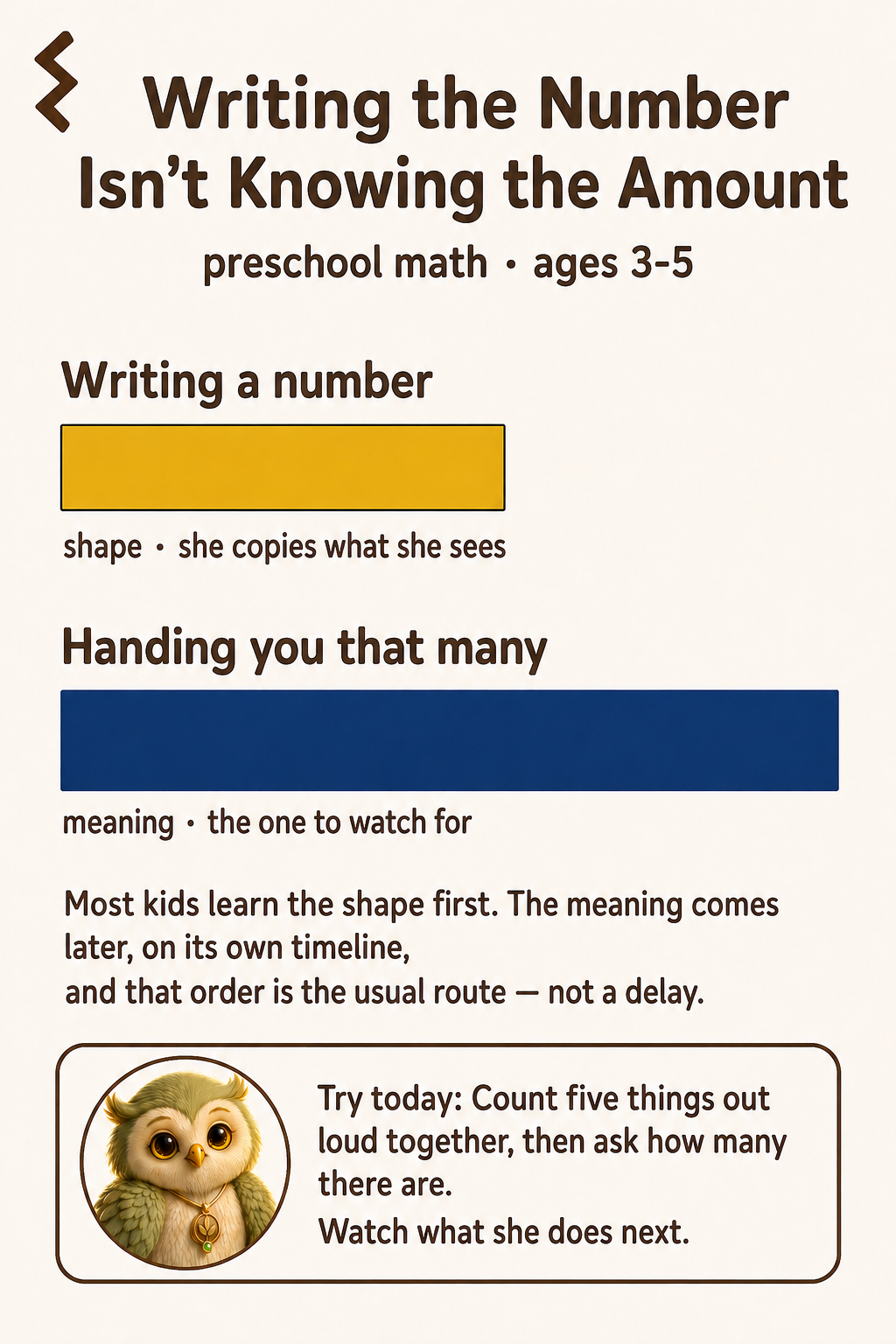
Writing a number and knowing what it means are two different skills. Most kids get the first one first, and the gap between them is normal at 3, 4, and 5.
If your child can write a 5 but can’t hand you five blocks, nothing has gone wrong. She learned the shape. The meaning comes on its own timeline, and there’s a two-minute check that tells you where she is right now.
The two-minute check
Put five small things on the table. Buttons, crackers, LEGO bricks, whatever is within reach.
Count them out loud together. One, two, three, four, five.
Then ask: “How many are there?”
That’s it. Watch what she does next.
What each answer tells you
- She says “five” right away. She knows that the last number you say is the answer, not just the last word in the song. Researchers call this the cardinal principle, and it’s the thing that turns counting into math.
- She starts counting again from one. She’s treating counting as something you do, not something that produces an answer. This is where a lot of 3- and 4-year-olds are, and it’s a stage rather than a problem.
- She says a different number. Also common. Try again tomorrow with three things instead of five. Smaller sets are easier to hold in mind.
There’s a second version of the same check that some kids find easier. Put out a big pile, maybe fifteen things, and say “Give me three.” If she hands you three and stops, she’s got it. If she keeps going or hands you a scoop, she’s still working on it.
One thing worth saying plainly: a single try on a single afternoon doesn’t settle anything. Kids are inconsistent at this age, and the same child can nail it Tuesday and miss it Wednesday. Use it to notice where she is, not to decide what she is.
Why the writing comes first
A written 5 is a shape. Learning to draw it uses the same part of a child’s day as learning to draw a star or write the first letter of her name. She can recognize it, copy it, and even name it out loud without connecting it to five of anything.
The meaning is a separate job. To know that 5 stands for a quantity, she has to hold the idea of “five things” in her head while looking at a squiggle that looks nothing like five things.
So the order most parents see, shape first and meaning later, isn’t a delay. It’s the usual route, and it’s the same reason counting to twenty tells you less than it seems to.
Three things to try this week
- Finish your counting out loud. When you count something, say the total at the end: “One, two, three, four. Four cups.” That last step, naming the whole set, is the exact move she’s learning. Clements and colleagues found in 2011 that this kind of explicit finish helps preschoolers connect the count to the quantity.
- Say numbers out loud in ordinary moments. “Two strawberries left.” “Grab as many forks as there are people.” No lesson, no quiz, just naming amounts while you do what you were doing anyway. Research on what’s called spontaneous focusing on number suggests kids who notice quantities on their own tend to pick this up more easily, though the link is a correlation and not proof that talking causes it.
- Ask for an amount instead of a number. “Bring me three socks.” Then let it go. If she brings four, that’s information, not a test she failed.
When this doesn’t work
If she’s tired, stop. This check needs about ninety seconds of attention. At the end of a long day you’ll learn nothing except that she’s done.
If she’s under 3, come back later. Asking “how many” right after a young child counts can sometimes make her second-guess an answer she already had. With a 2-year-old, counting together and stopping there is plenty.
If she gets it one day and not the next, that’s the age. Consistency shows up gradually. The goal this year is that the idea exists, not that it’s reliable. The same thing happens with a worksheet she aced last week and can’t do today.
When to talk to someone
Most of what’s above is ordinary development. Some things are worth raising with her teacher or pediatrician, not because they mean something is wrong, but because they’re easier to look at early:
- she isn’t using number words at all by around 4
- she counts the same object twice or skips objects every single time, even with three or four items and no rush
- something else about her language or attention has been bothering you, and this is one more piece of it
You’re not asking for a diagnosis. You’re asking someone who sees a lot of 4-year-olds whether this looks like the range they usually see.
The part worth remembering
Counting to twenty is a song until the moment your child can answer “how many.” That moment is the one to watch for, and it usually arrives quietly, months after she can write the numbers.
Free printable: Find the Acorns — four levels of searching and counting, one page each. Print the level that matches where your child actually is, not the one that matches her age.
No reading required · Prints clean in black and white · One task per page