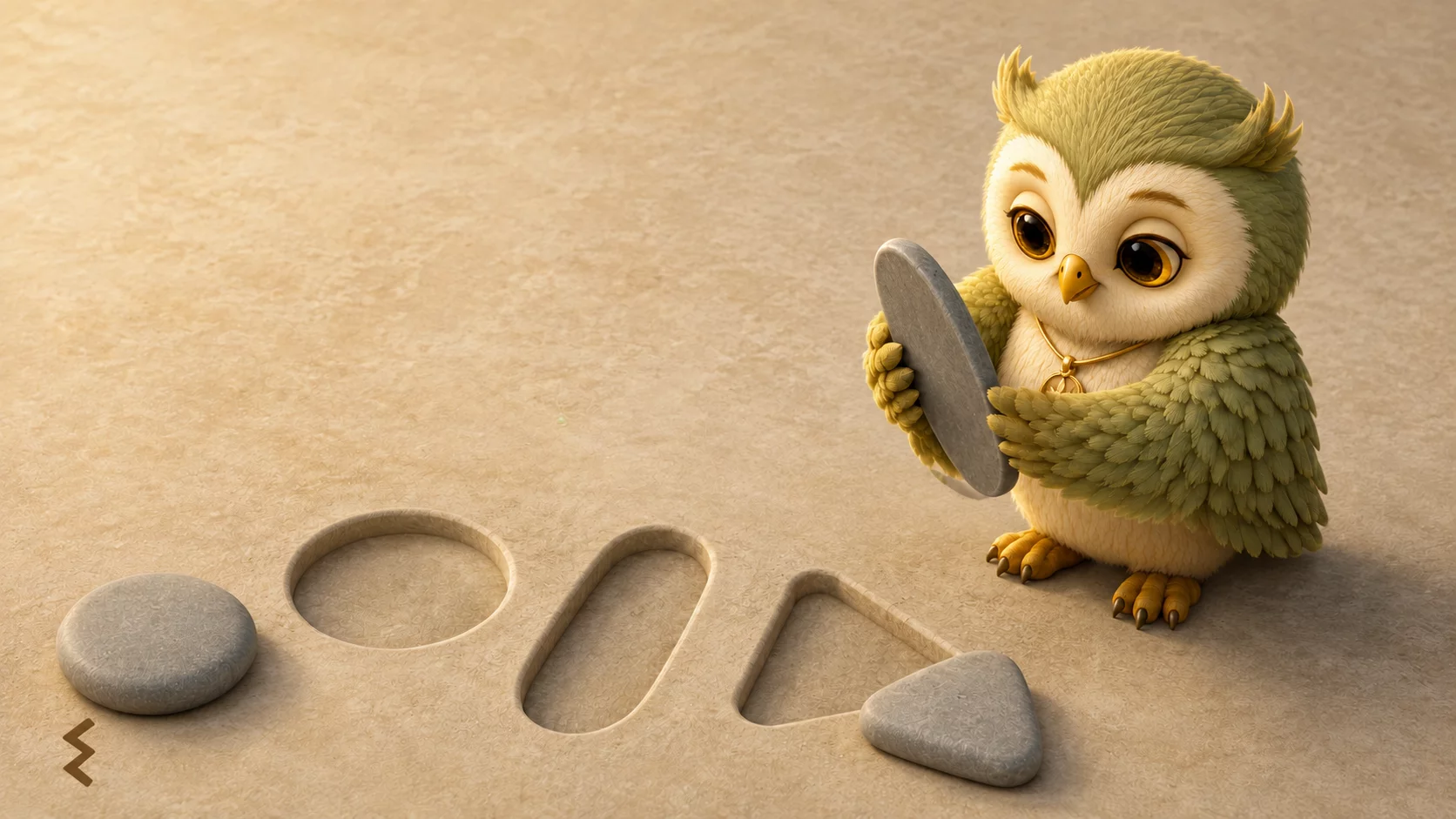
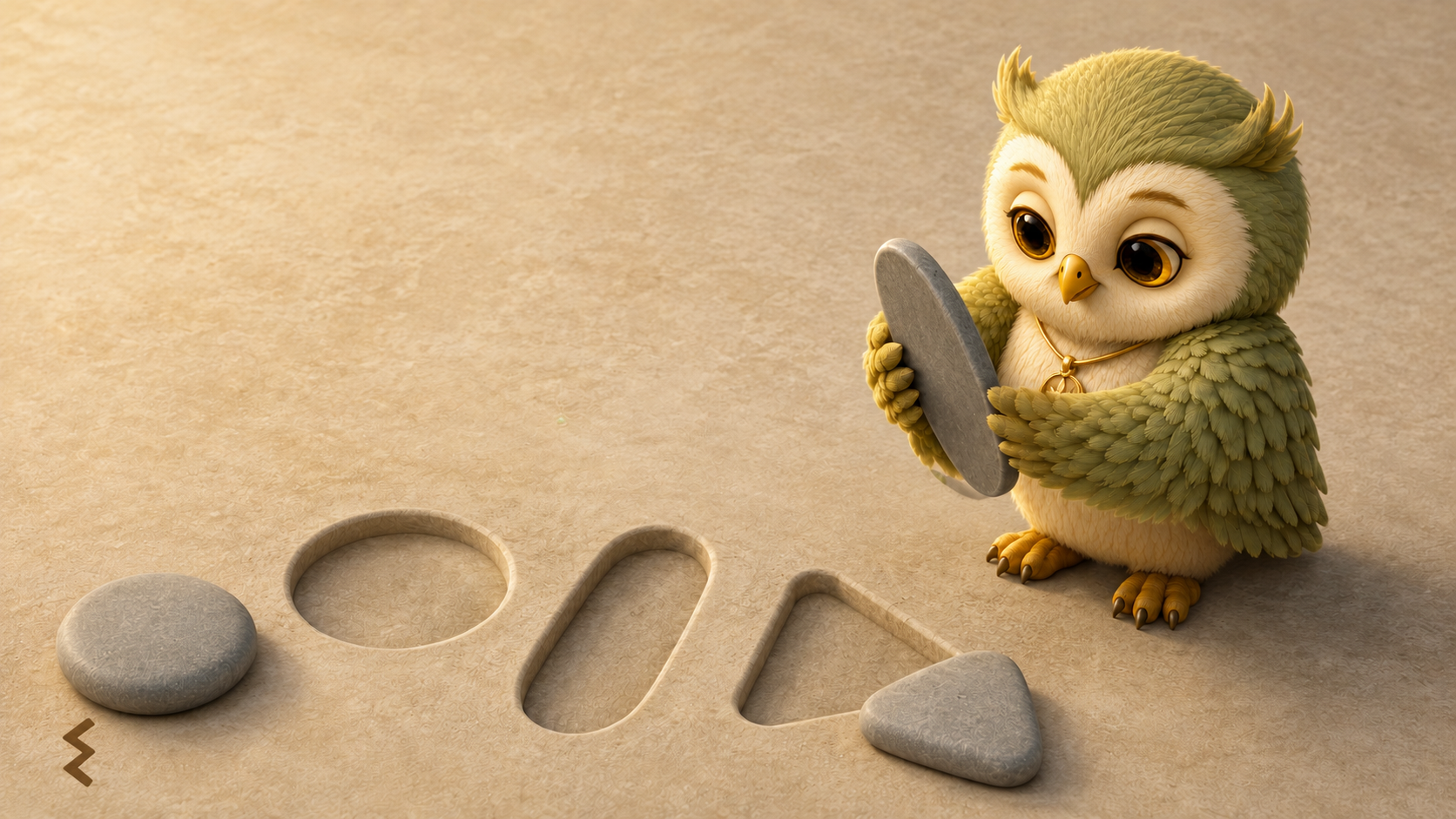
She’s been trying to get the same block into the same hole for a full minute. She turns it, tries, turns it again, and finally it drops through.
Nothing about that looks like math. There’s no number in it anywhere. It’s still one of the most mathematical things she’ll do all day.
What turning a block actually is
To fit that block, she has to hold a shape in her head, imagine it in a different position, and compare that imagined version to the hole in front of her. Then she has to move her hands to match.
Adults do this constantly and stop noticing. Loading a dishwasher, packing a car, working out whether the sofa gets through the door. It’s the same operation every time, and it’s the part of math that lives in space instead of in numbers.
Early math conversations almost never mention it, which is strange, because it’s the half most children are best at and enjoy most.
Give her things that only fit one way
You don’t need a shape sorter for this. A drawer of lids and containers does it better, because the fit is real and the feedback is instant.
Put out four containers and their lids, mixed up, and let her sort out which goes with which. She’ll pick lids up, hold them over openings, and rotate them without being told to. That rotating is the whole exercise.
Packing the lunchbox works the same way, and so does putting the shopping in one bag when there’s clearly too much for one bag.
Use the words while she does it
Under, over, behind, between, next to, on top of, upside down, the other way around. These are position words, and they’re doing more work than they look like they’re doing.
You don’t need a lesson. Narrate what’s happening while she plays. “That one goes behind the tall one.” “Try it the other way around.” A child who hears those words while handling the objects picks them up far faster than one who hears them pointed at a picture.
Build something and then copy it
Make a small tower of three or four blocks. Give her the same blocks and ask her to build the same thing.
This is harder than it sounds, because she has to look at your tower, break it into parts, and rebuild it from her side of the table, where it faces the other way. Start with three blocks. Add one when three stops being interesting.
Then swap. Let her build and you copy. Getting it wrong on purpose is allowed and highly recommended.
The thing not to say
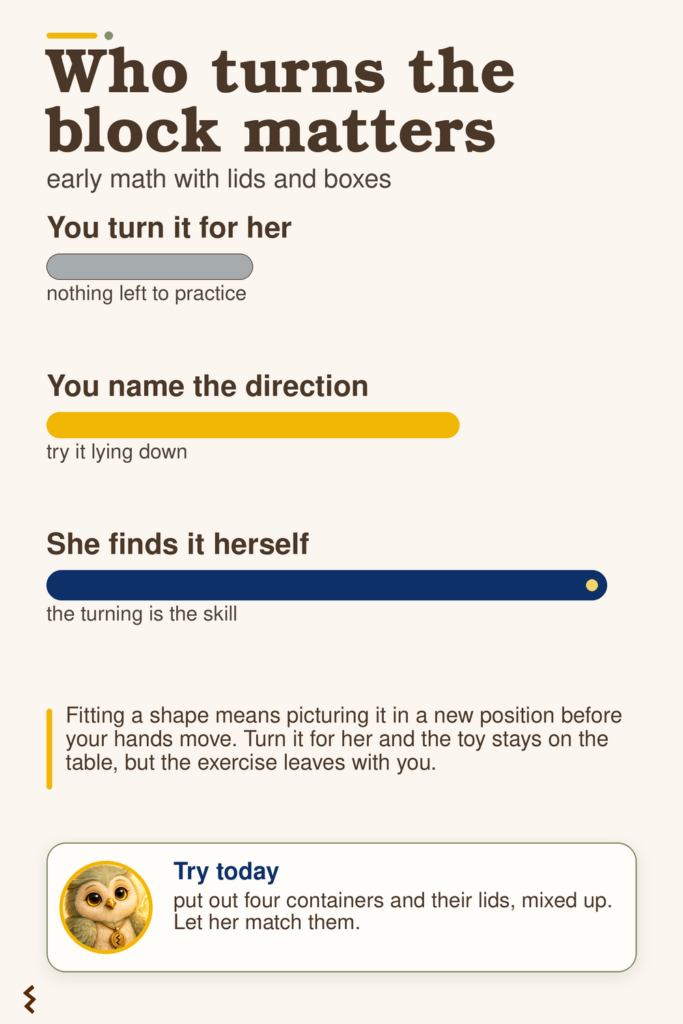
Don’t take the block and turn it for her.
It’s almost impossible not to, because watching a child try the same wrong angle six times is genuinely uncomfortable. But the turning is the thing being practiced, and doing it for her removes the entire exercise while leaving the toy in place.
If she’s stuck and getting cross, name the direction instead of moving her hands. “Try it lying down.” That leaves the work with her.
The part worth remembering
Math at this age isn’t only the part you can hear. A lot of it happens in silence, with hands, and it looks so much like ordinary play that we walk past it looking for something more educational.
If you want the other pieces that hide in plain sight, we wrote about why comparing comes before counting and about seeing an amount without counting it.
Free printable: Find the Acorns — four levels of searching and counting, one page each. Print the level that matches where your child actually is, not the one that matches her age.
No reading required · Prints clean in black and white · One task per page