Most number workbooks start with 1, then 2, then 3, in counting order. Our pages start with 1, 4 and 7, and they don’t let a child write a digit until they can count that many things.
Those two rules sound fussy until you watch a 3-year-old try to write a 5 the week after a 1. Here’s why the order changed.
Why count before writing?
Because a 4 is just a shape until your child knows what four is.
Kids can trace a 4 beautifully and have no idea it means four of anything. It looks like progress and it fades fast, because the shape is attached to nothing. So every digit page opens with objects: four pine cones, seven leaves, six berries. The child touches them, counts them, and only then picks up the crayon.
If your child can’t count out four things yet, skip the 4 page. That isn’t falling behind. It means there’s more counting to do first, and counting beats tracing anyway.
Why start with 1, 4 and 7?
Counting order is about numbers. Writing order is about the hand.
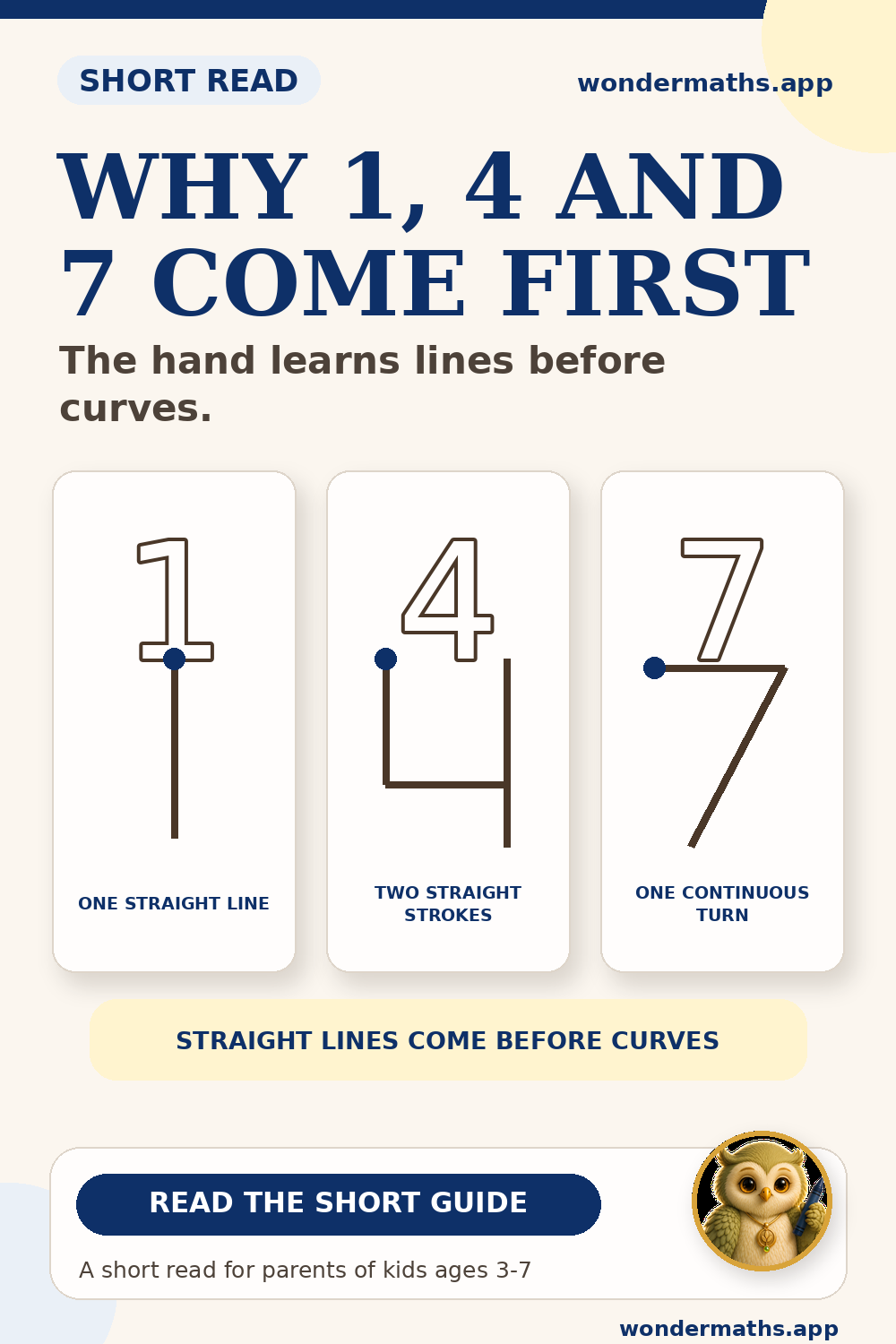
A 1 is one straight line. A 5 is a line, a stop, a curve, a lift and a second stroke. Those aren’t the same skill, and asking for the 5 right after the 1 just because 5 comes later in counting is asking for a fight.
So the digits are grouped by what the hand has to do:
- Straight lines only: 1, 4, 7
- One round loop: 0
- Curves that turn right: 2, 3
- A loop with a tail: 6, 9
- Change direction mid-stroke: 5, 8
This is our own ordering, built from how the strokes work, not from a study ranking digits by difficulty. The idea came from handwriting programs that group letters by stroke instead of by alphabet, including the free program from the Iowa Reading Research Center.
What about 6 and 9?
Kids mix up 6 and 9. They mix up 2 and 5. Most workbooks put those pairs on facing pages, which is the worst place for them.
Here, 6 and 9 never sit on neighboring writing pages. A review page stands between them. Same for 2 and 5. When the pair finally meets, it’s on purpose, with one question: “Door at the bottom or door at the top? Point to the 6.” The child looks before they write.
What does one page ask a child to do?
Four steps, same order every time.
- Count. Objects at the top. “Show me four pine cones.”
- Trace. A big digit with a start dot and arrows.
- Try. Empty boxes with only the start dot.
- Check. Cover the model, write, uncover, compare.
At the bottom of each page there’s one line to read out loud. For the 1: “One acorn. One line, top to bottom. Stop at the dot.” You don’t have to invent anything on the spot.
Can you try this without printing anything?
Yes, and it takes about three minutes.
Put four of anything on the table. Spoons, blocks, crackers. Ask: “Show me four.” Then wait.
If your child touches each one and lands on four, draw a dot on a piece of paper and say: “Start here. One line, straight down.” That’s the 1, and you’ve done the whole method with a crayon and a napkin. If they skip a spoon or count one twice, put the crayon away and keep counting spoons for a few days.
When should you ask someone?
Backward digits, wobbly lines and a fist grip are ordinary at 3, 4 and 5.
If your child is 6 or older and still can’t copy a circle or a cross, or gets upset every time a pencil appears, mention it to your pediatrician or at a parent-teacher conference. That’s a question, not a label.
Free ebook: Count It First. Then Write It. Twenty-six pages that take a child from counting objects to writing the digit, one number at a time, in the order the hand is ready for.
Ages 3 to 7 · Prints clean in black and white · One digit per page · We send the PDF and nothing else