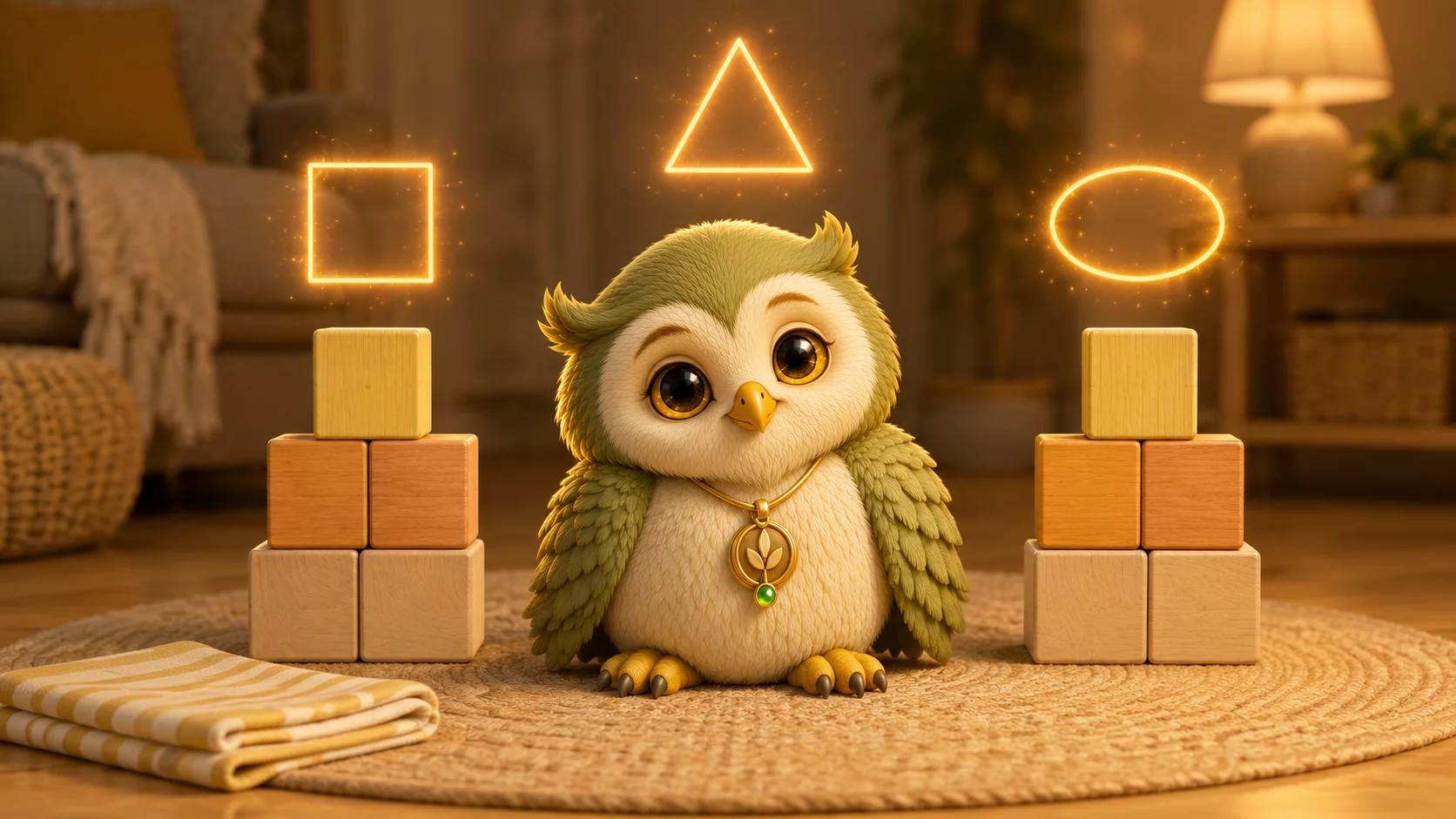
If your child heads for the blocks every time you get out something number-shaped, you don’t have a problem. Building, copying, matching and turning things are math too, and they’re the part most of us skip because it doesn’t look like math.
Here’s a five-minute version you can do with blocks you already own.
What do you need for this?
Eight to ten blocks, split into two matching sets: four or five for you, the same four or five for your child. Duplo, wooden blocks, magnetic tiles, even stacked books work.
Matching sets matter. If your child doesn’t have the same pieces you do, the task turns into a hunt instead of a copy.
- Ages: 4 to 6
- Skill: copying a shape, then rebuilding it from memory
- Time: five to ten minutes, no prep
- Cost: nothing, and no printer needed
How do you actually run it?
Build something small, four or five blocks. Keep it simple enough that you could describe it in one sentence. Then leave yours sitting in plain view.
Say: “Can you make one just like mine?”
When it’s done, put the two side by side. Don’t announce what’s different. Ask.
Say: “What do you notice?”
Now hide yours under a dish towel and ask your child to build it again from memory.
Say: “Ready? Now build it without looking.”
Lift the towel together. Whatever happened, look at both.
Say: “What did you remember? What surprised you?”
What’s the harder version?
Once copying is easy, add a turn. Build something, then point at a spot across the table.
Say: “Build the same thing, but the way it looks from over there.”
Your child has to picture the shape from a different side before their hands move. That’s a genuinely hard task, and a four-year-old who tries is doing real work even when the result looks nothing like yours. Turn your own build slowly and let them check.
Why does this count as math?
Building a copy asks your child to hold a shape in mind, break it into parts and put it back together. Hiding the model turns it into memory work. Turning it adds a mental rotation, picturing the thing from a side you can’t see.
Researchers Hawes, Gilligan-Lee and Mix reviewed studies on training these spatial skills in children and found the skills themselves improve with practice. Whether that carries over into better math results is a separate question and the evidence there is much thinner, so I won’t tell you this raises math scores.
What it does do: it gives a child who avoids number work a way into the same room, and it’s the kind of task most kids keep doing on their own after you walk away.
How do you make it easier or harder?
Easier: three blocks instead of five, all different colors, and skip the hiding step. Build side by side, one piece at a time, narrating as you go. Say: “I’m putting the red one on top. Your turn.”
Harder: add a mirror version. Build something with a clear left and right, then ask your child to build its reflection, the way it would look in a mirror. Or build with your child’s eyes closed, let them look for five seconds, cover it, and build.
The signal to move up: they copy a five-block build correctly from memory on the first try, twice in a row.
What if it doesn’t go well?
- They build their own thing instead. Let them. Then ask “can I copy yours?” and do the task in reverse. Same skill, and now they’re teaching.
- They give up when the copy is wrong. Take the correction off the table. Say: “Let’s put them next to each other and just look.” Noticing the difference is the whole exercise. Fixing it is optional.
- It falls over. Build lower, two levels instead of four.
- A younger sibling wrecks it. Build on a tray you can lift out of reach, or give the little one their own pile to smash.
Why doesn’t anyone search for this?
Almost nobody types spatial math activities into a search bar. Parents search for counting, because counting is what looks like math.
That’s exactly why this is worth doing. Building, copying and turning are the underserved half, and your child probably likes them better than the counting half. The same goes for the pattern work most of us skip.
What comes after this?
When copying from memory is comfortable, put four shapes down and ask which one doesn’t belong. Accept any answer your child can explain. It’s the same noticing muscle, pointed at a different question.
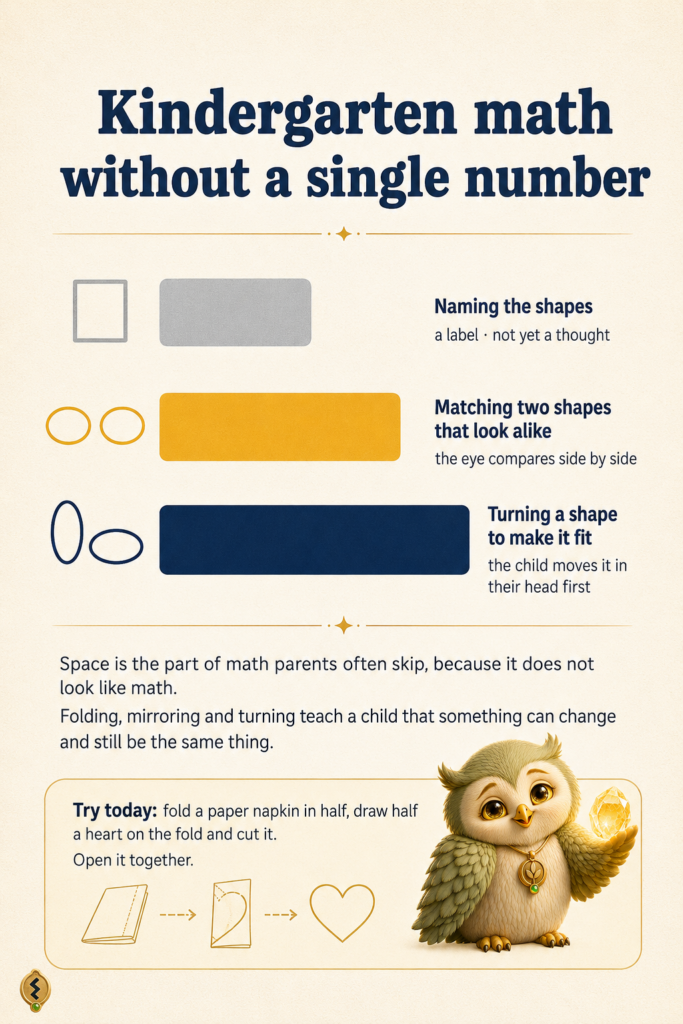
Free printable: Make It the Same — a shape on one side of the page and an empty grid on the other. Your child copies what they see, square by square.
Four levels in the set · One card downloads right away, no email · Prints clean in black and white