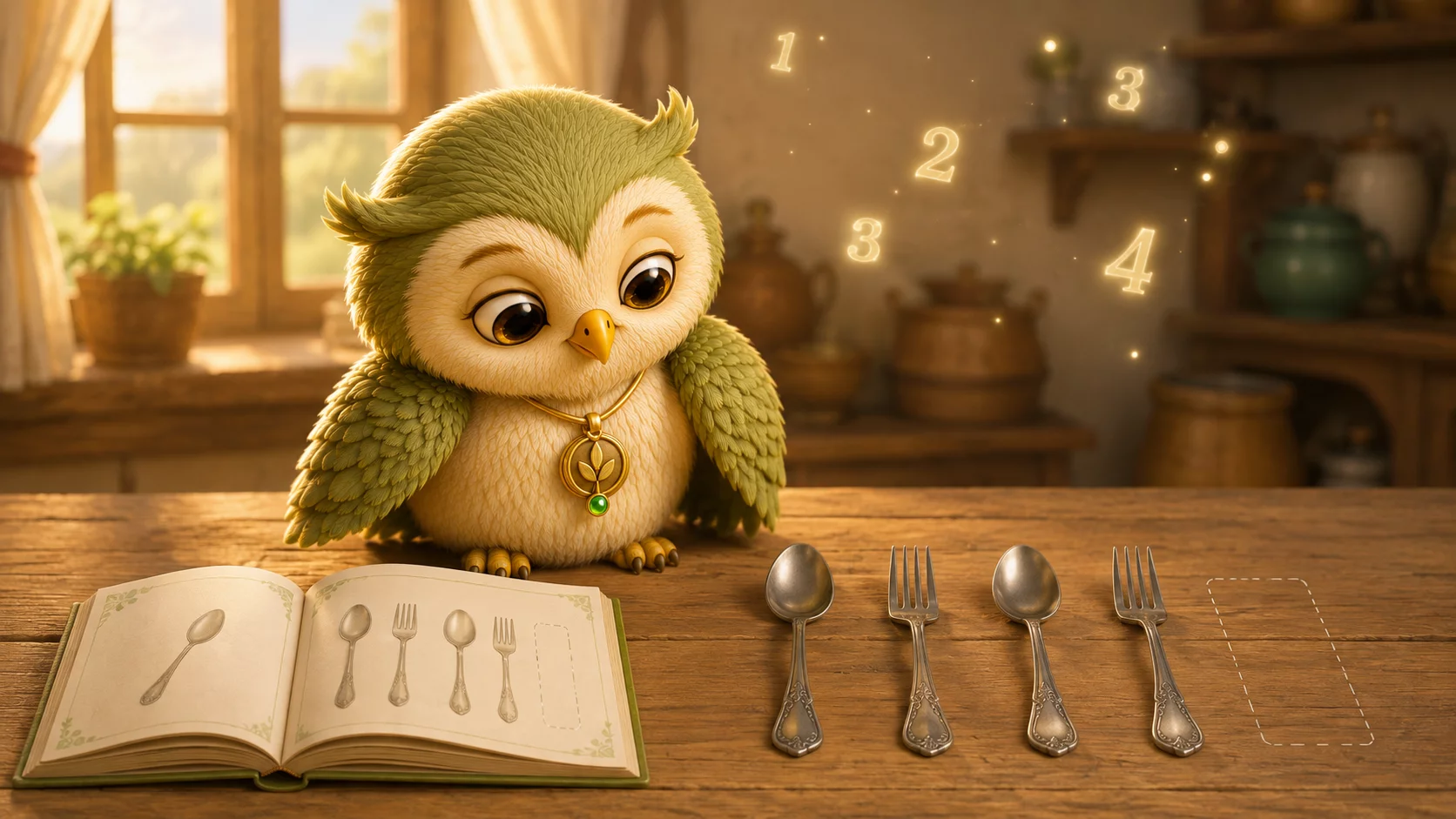
You don’t have to pick. At 3 and 4, math takes about ten minutes a day, and most of it happens while you’re already doing something else.
What trips parents up is the picture of “math” they carry around: numerals, flashcards, a workbook. At this age, math is noticing. Which cup has more. What comes next in the row. Which two socks are the same. Reading gets its own slot on the couch. Math rides along with snack.
What does math even look like at 3 and 4?
Three things, and none of them need a written number.
- Patterns: spoon, fork, spoon, fork, and your child says what comes next. That’s a rule, carried forward. It’s the same move they’ll use later with numbers.
- Comparing: two plates of crackers, “which one has more?” No counting needed, and the answer teaches the idea of amount.
- Same and different: matching socks, sorting spoons from forks. Sorting is what counting sits on top of.
Numerals come later, and nothing is lost by waiting. A 4-year-old who can tell you the row goes “spoon, fork, spoon, fork” has done more math than one who traced a 7. If you want a full set of these, we wrote up pattern activities for preschoolers that all use things from the kitchen drawer.
How much time does it take?
About ten minutes, and they don’t have to be in a row. Most of it is saying the amount out loud when it’s already in front of you: “three strawberries left,” “grab as many forks as there are people,” “look, two rows of four.”
One study of families with young kids (Levine and colleagues, 2010) found that children who heard more of this everyday number talk at home tended to do better on a number task a year later. That’s a link, not a cause, and the study didn’t test homeschoolers specifically. But it costs nothing, so it’s a good place to start.
So which one first, honestly?
Whichever your child reaches for. If she’s pulling books off the shelf, read. If she’s lining up her cars by color, that’s math already; sit down next to her and ask what goes next.
Here’s how it usually shakes out in practice, not because anyone tested it but because it holds up: the skill that needs focus (for many kids that’s letters and sounds) gets the fresh part of the morning. Math gets the gaps: snack, setting the table, waiting for the bath to fill. Ten minutes of gaps is a lot of math.
Try this today: the ten-minute version
You need two kinds of small things. Spoons and forks, blocks in two colors, crackers and grapes.
- Minute 1–3: the row. Lay out spoon, fork, spoon, fork. Say it out loud together. Then: “What comes next?” Let your child pick and place it. Do three rows.
- Minute 4–6: two plates. Put two crackers on one plate and six on the other. “Which plate has more?” Then swap: “Which has less?”
- Minute 7–10: the twin. Hold up one sock. “Find the one that’s the same.” Mix in a few that are close but different.
Make it easier: two objects only, and you say the row first. Make it harder: spoon, fork, fork, spoon, fork, fork. If it falls apart: stop, eat the crackers, try again tomorrow. Nothing is lost.
Comparing plates leads straight into the idea that amount and space are different things. That one’s worth its own read: more or less, before counting.
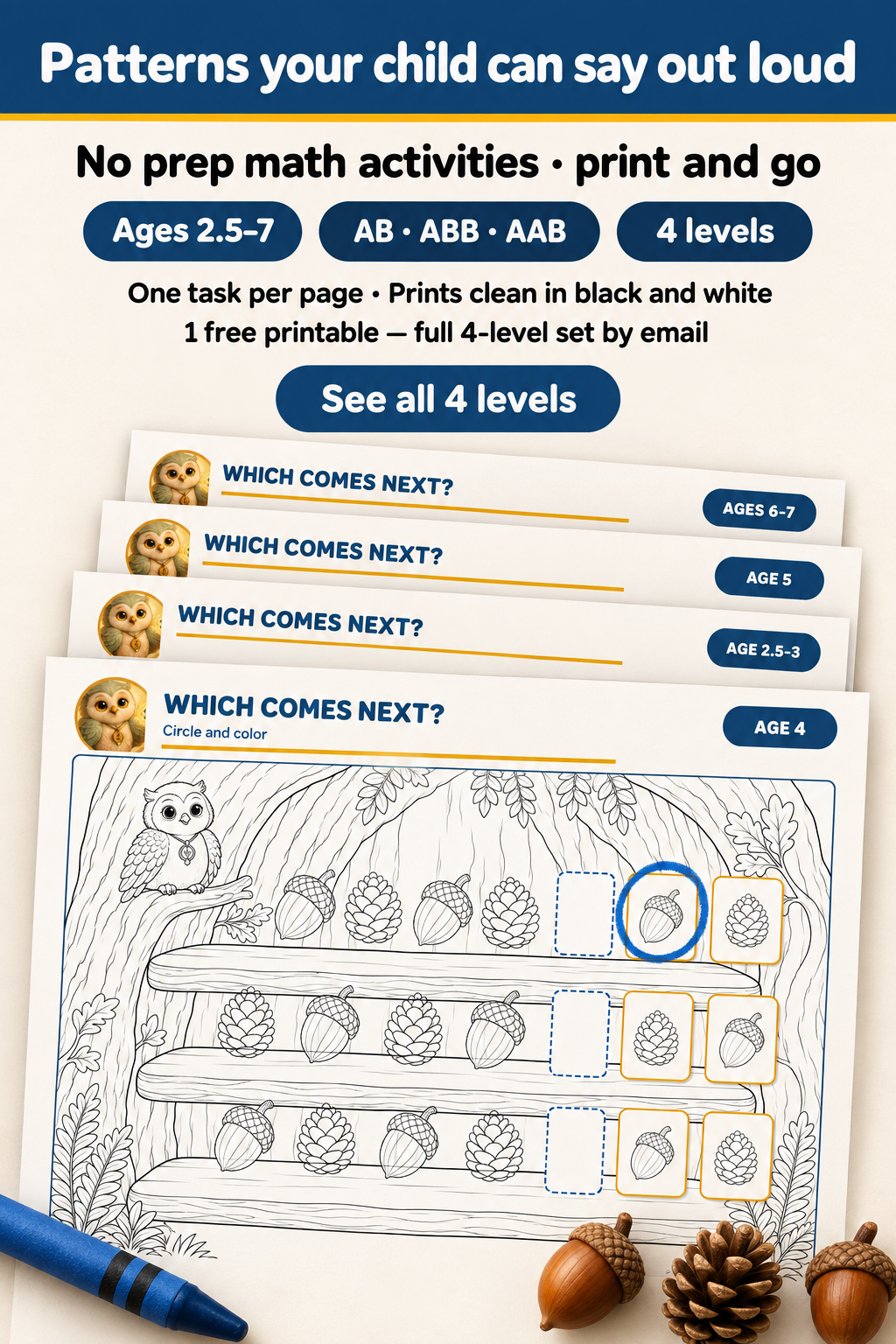
Free printable: Which Comes Next? — rows of acorns and pinecones with one empty spot. Your child points to, places, or circles what comes next. Four levels from 2.5 to 7, from AB up to ABB and AAB. The age-4 page is free; the full set comes by email.
No reading required · Prints clean in black and white · One task per page