Grade placement is a school decision, and a good one looks at the whole child: reading, writing, friendships, how she handles a full day. What you can figure out at home is what “ahead” means. Fast counting and big numbers are one kind of ahead. Understanding is another, and it’s the one that carries into second grade and beyond.
Here’s a two-minute way to tell them apart, what to do with a kid who’s ahead, and what to ask the teacher if you decide to raise it.
What does “ahead” usually look like at 5?
Counting to 100. Adding in her head. Reading numerals off the microwave. These are real skills and they’re worth being pleased about. They’re also the most visible skills, and the easiest to pick up by memory. A child can do all three and still believe that six acorns spread out on a plate is more than eight acorns in a pile. Plenty of 5-year-olds do, and that’s a common stage rather than a mistake.
That’s the difference you’re checking for. Speed says how much she’s memorized. Depth says whether the numbers mean amounts to her yet.
How do I check for depth in two minutes?
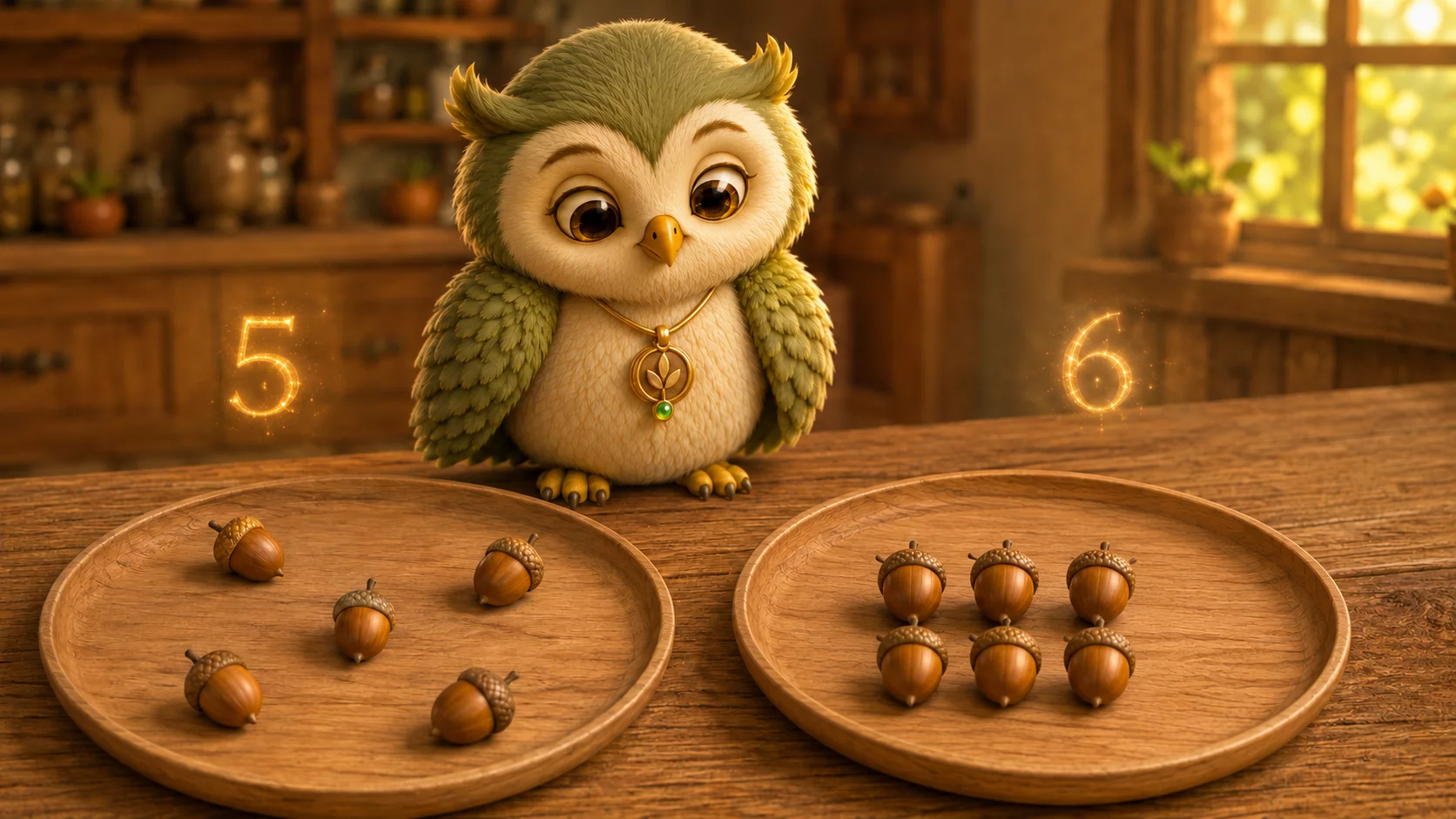
Two plates. Five acorns (or coins, or crackers) spread far apart on one plate. Six packed tight on the other. “Which plate has more?” Then: “How do you know?”
If she counts before answering, or says “that one, it looks like more, but let me check,” she’s thinking about amount. If she points at the spread-out plate with confidence, she’s going on space, and that’s where researchers like Clements and Sarama place a lot of 5-year-olds along the usual path. Neither answer is a verdict. It tells you which conversation to have next.
Under the cup. Seven acorns on the table. She counts them. You hide three under a cup while she watches. “How many are hiding?” A child who’s memorized adding may still need to count what’s left and work backward. A child who sees seven as “four and three” answers straight away.
What do I do with a kid who’s already ahead?
Go sideways, not up. Bigger numbers are the obvious next step, and they’re the one that adds the least. Depth comes from the same small numbers asked in harder ways.
- Ask “how do you know?” after every right answer, and then wait. Count to three in your head before you say anything. Mary Budd Rowe’s classroom research in the 1970s and 80s found that a few seconds of silence gets longer, better explanations out of kids. It works at the kitchen table too.
- Ask for a second way. “You got seven. Can you show me another way to see it?” Six is three and three, four and two, five and one. Same number, different pictures.
- Break the pattern on purpose. Lay out acorn, pinecone, leaf, acorn, pinecone, leaf, and slip in a mistake. “Something’s wrong in this row.” Finding the rule beats extending it. More of these in pattern activities for preschoolers, and the harder versions there are the ones to use.
- Praise the move, not the kid. “You counted from the bigger pile. Smart way to do it.” Work by Gunderson and colleagues suggests this kind of praise, aimed at what the child did, holds up better over time than “you’re so smart.” It’s a moderate finding, not a law, and it costs nothing.
The two-plates check leads into a bigger idea, that amount and space are different things, and there’s a full version of it in more or less before counting.
What should I ask the teacher?
Three questions that get real answers
- “What do you see when she’s asked to explain an answer, not just give one?”
- “Where does she land compared to the range you usually see this time of year?”
- “If we wanted more depth instead of a grade change, what would that look like in your room?”
Teachers see 25 kids this age every day and will tell you quickly whether your child stands out and in which way. Skipping a grade is sometimes the right call. It’s their call to weigh, with you, and the two-minute check gives you something concrete to bring to that conversation.
Free printable: Which Has More? — two plates of acorns, side by side, three pairs per page. Your child looks first, then counts to check, and circles the plate with more. The spread-out plate shows up on the way to 8. Four levels from 2.5 to 7. The age-4 page is free; the full set comes by email.
No reading required · Prints clean in black and white · One task per page