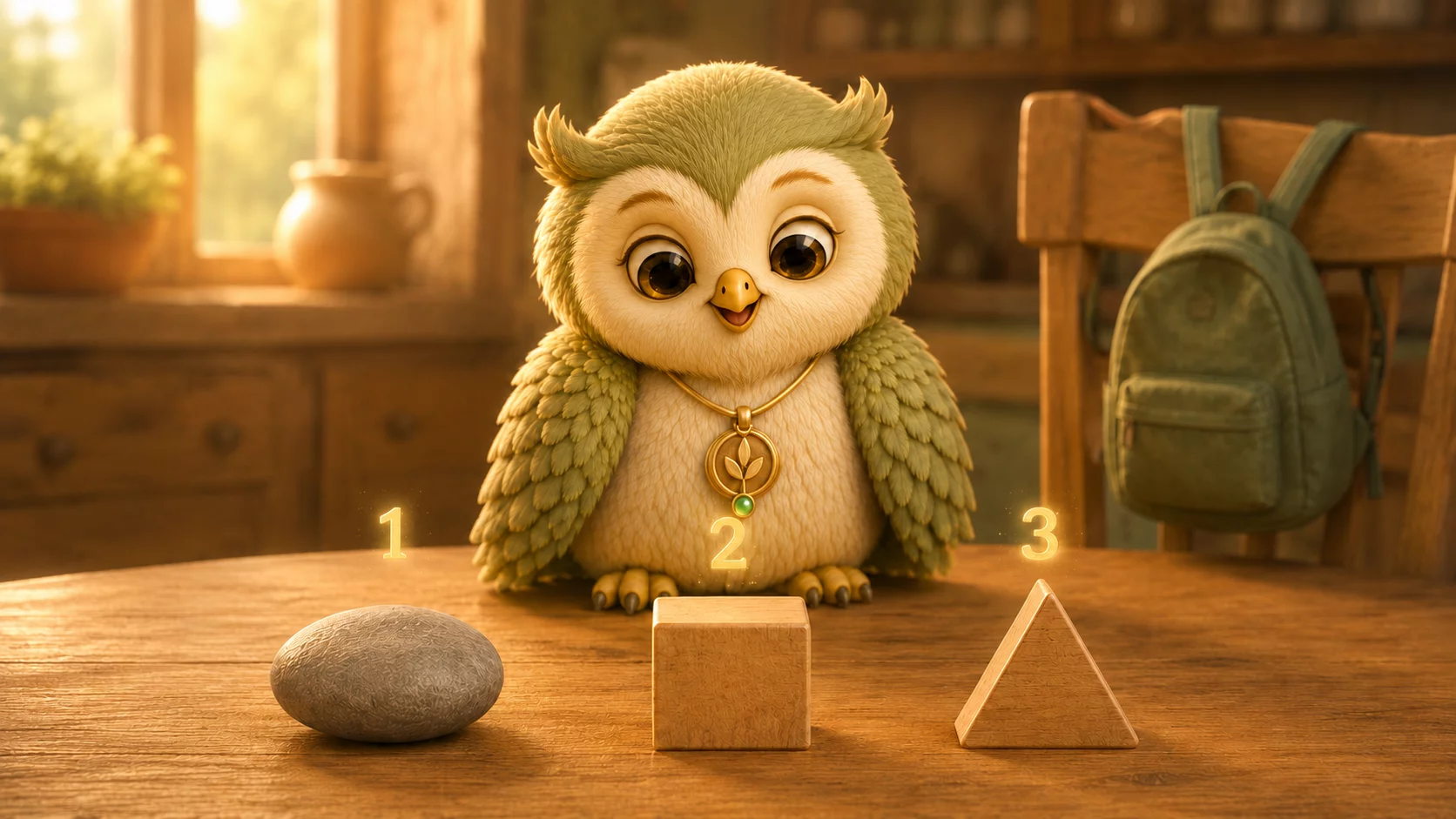
Kindergarten math starts with five ideas, and you can check each one at the kitchen table in about two minutes. None of them need a written number. Most kids arrive with some and pick up the rest during the year; that’s what the year is for.
One thing before the list. If you’re weighing whether to hold your child back a year, this won’t decide it. That’s a decision about the whole child, and your child’s preschool teacher and the kindergarten teacher are the right people to weigh it with. What this gives you is a clear picture of where the math is today, so that conversation has something concrete in it.
1. Can she count a small group and say how many?
Five crackers in a row. She counts them, touching each one. Then you ask: “So how many?” If she says “five” without counting again, she’s got it. If she recounts, she’s partway there, which is common at this age. Kindergarten spends a lot of time here on purpose. The full check and what helps is in counts to 20 but can’t count 5 things.
2. Can she tell which has more?
Two plates, three crackers and seven crackers. “Which has more?” Then make it closer: four and six. Then the same amount on both: “Same, or different?” A child who handles the first and stalls on the close one is right where many 5-year-olds are. The idea that “same” is an answer is the part kindergarten builds on.
3. Can she carry a pattern forward?
Spoon, fork, spoon, fork. “What comes next?” Then a harder one: spoon, fork, fork, spoon, fork, fork. Patterns are how kids first meet the idea of a rule, and rules are what the rest of math runs on. There’s a whole set of these in pattern activities for preschoolers.
4. Can she find a shape in a real thing?
Not a flashcard triangle. A tent.
Point at the clock: “What shape is that?” Then a window, a slice of pizza, a stop sign on the walk. Naming a triangle on a card is memory. Spotting one in a slice of pizza that’s sitting sideways is the skill. If she names the card and misses the pizza, that’s the next thing to play with, and it’s an easy one to practice on any walk. More on this in space and shapes at home.
5. Can she sort, and say why?
A handful of mixed silverware, or blocks in two colors. “Put the ones that go together in a pile.” Then: “Why do those go together?” The sorting is common by 4. The “why” is what you’re listening for at 5, because explaining a rule out loud is what kindergarten math looks like all year.
What if my child does two out of five?
Then you have a normal 5-year-old and a short list. Pick one thing from the list and play with it for a week, in the two-minute versions above. These come in any order, and none of them is a gate. Kindergarten teachers expect a wide range in September; they see it every year.
If you do want to talk it through with the preschool teacher, ask: “Where does she land compared to the range you usually see at this point?” and “Which one of these would you play with first?” Those get you a real answer instead of a reassurance.
Try this today: pick one
If you only do one thing from this post, do the two plates. It takes ninety seconds, it uses whatever snack is already out, and the “same, or different?” question at the end tells you more than the other four combined.
Free printable: Shape Hunt — a circle, a triangle, and a square on one side; a tent, a wheel, a crate, and a stick on the other. Your child draws a line from each shape to the real thing that has it, and one thing matches nothing. Three shapes, four levels from 2.5 to 7. The age-4 page is free; the full set comes by email.
No reading required · Prints clean in black and white · One task per page