
Most addition worksheets open with a plus sign. A row of them, actually — 2 + 1, 3 + 2, 4 + 3 — and a box at the end waiting for a number.
For a child who already understands what adding is, that page is practice. For a child who does not yet, it is a code with no key.
What has to happen before the symbol
Adding starts as something you do with your hands. Four acorns in one basket, three in another, tip both into a third, count what is there. No writing, nothing to decode, and the answer is sitting on the table where anyone can check it.
Do that a dozen times over two weeks and something shifts. Your child stops recounting the first group from one, because they have started to trust that four is still four after you look away. That trust has a name — cardinality — and until it arrives, a plus sign is decoration.
So the first pages of Book 1 have no numerals on them at all. Acorns, baskets, and a frame that holds five. The symbol turns up on page eleven, and by then it is a shorthand for something the child has already done with their fingers.
The order the eight worksheets follow
- One more acorn — adding one, and nothing else. The smallest possible step away from counting, and for a lot of children the one that takes longest.
- What is missing to five — a frame with five squares, some of them filled. Number pairs that make five are the foundation every later strategy leans on.
- Two baskets, one pile — joining two groups. Still no plus sign, still no numerals.
- Twins — doubles. These are the facts children recall fastest, and knowing them makes near-doubles almost free.
- Make ten first — eight plus seven is hard. Eight plus two is easy, and then there is five left over. This is where the numerals arrive.
- Past ten — the same idea on a number line, plus one task running backward: something plus six makes fourteen, what was it?
- Bundles of ten — tens and ones. Why 23 + 4 changes the ones and leaves the tens alone.
- Fill the basket — no right answer. Your child fills it however they like.
That last one matters more than it looks. Children who invent their own quantities understand them better than children who only ever respond to someone else’s.
Three ways to ask, not one
A page can be finished correctly and understood barely at all. The difference shows up when you change the direction of the question.
Forward is the usual one: what is eight plus seven.
Backward is the one almost nobody asks: something plus three makes eight — what was there first? Same fact, running the other way, and much harder to fake.
Sideways tests whether the idea travels: if eight plus seven works this way, what about twenty-eight plus seven?
A child who can only go forward has memorized something. A child who can go backward and sideways owns it. And when backward is the one that stalls, that is not failure — it is a signal that the idea needs a few more turns with real objects before the symbol can carry it.
What the pages between the worksheets are for
Eight of the nineteen pages are not for your child at all.
One is a fifteen-minute rhythm: three minutes of questions from earlier days, one new idea, some back and forth, one task in a new setting, and a final question with no number in it. One is a page of sentences for the six moments where a session usually stalls — what to say when they are guessing, when they are right but cannot explain, when it is far too easy. One tells you when to come back to an idea, which turns out to matter more than how long you spend on it the first time.
Eight problems today and a return in two days will do more than forty problems in one sitting. The coming back is the method, not a detail of it. If you would rather start with something smaller tonight, the single-page printables ask for one thing each.
One thing worth saying out loud
The stretch between counting and adding is uncomfortable to sit in, because a child in it can look like they are going backward. They counted to twenty last month, and today they cannot tell you whether four or six is more.
They are not going backward. They are working on something underneath the counting, and it does not show until it is finished. More on how these pages are made, if you want the longer answer.
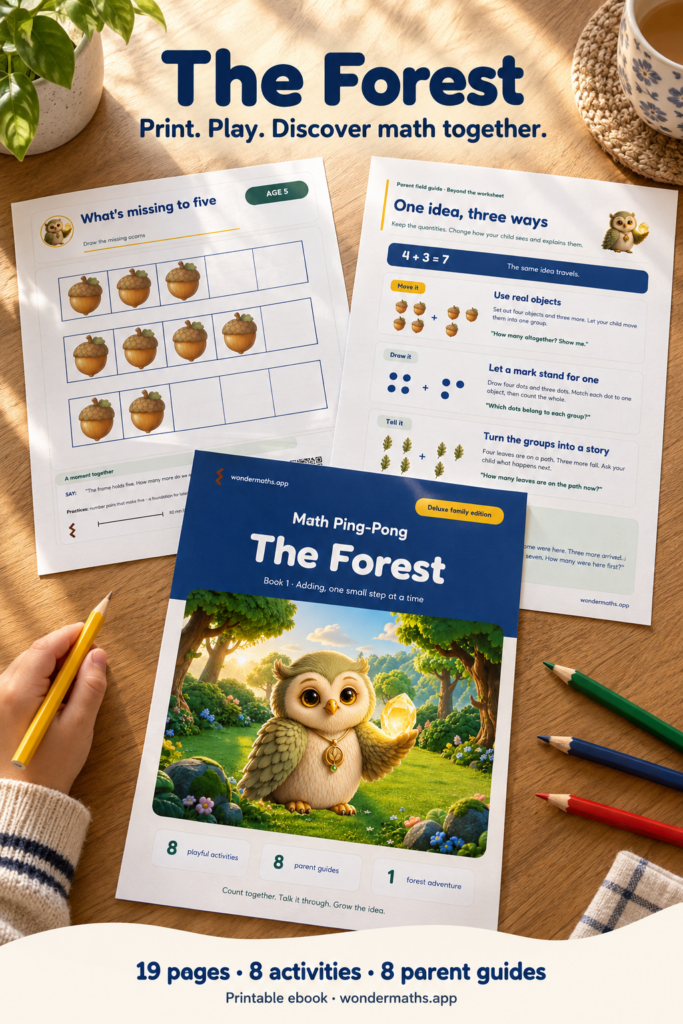
Free ebook: Math Ping-Pong · Book 1 · The Forest — eight worksheets that go from putting one more acorn in the basket to tens and ones, plus eight short pages for you and a full answer key.
Nineteen pages, US Letter · No reading required · Prints clean in black and white · Quantity first, numerals last