
Most pattern worksheets ask “what comes next?” This set asks “what’s missing in the middle?” It sounds like the same thing. It isn’t.
To fill a gap, a child has to read the pattern on both sides of it and find the rule that makes them agree. That’s a bigger job than adding one more leaf to the end, and it’s the job the What Fits in the Gap? set builds up to over four levels. It starts with something much smaller: finding a leaf that looks the same.
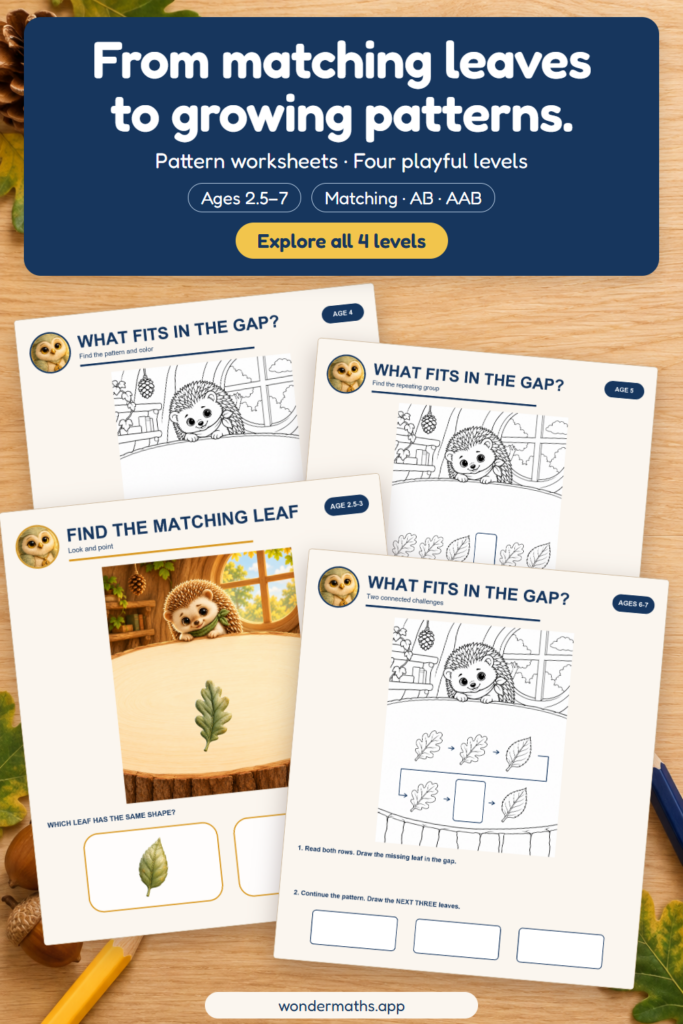
Why start with matching instead of patterns?
Because a pattern is made of “same” and “different,” and a two-year-old is still sorting out which is which. Before a child can see that oak, oak, maple repeats, they need to be sure which leaves are oak. Matching is where that certainty comes from.
If you’ve read our piece on why patterns are math too, this set is the practice side of that idea, one step at a time.
What does each level ask the child to do?
- Age 2.5 to 3, full color: one leaf on the table, two below. Which one has the same shape? Look and point. No crayon.
- Age 4, outlines to color: a short AB pattern with one gap. The child finds the pattern and colors the missing leaf. Two kinds of leaf, so the rule is easy to see and the gap is easy to fill.
- Age 5: find the repeating group. The pattern is AAB now, so the child has to notice that the unit is three leaves long before the gap makes sense. Most kids need to say it out loud a few times: “oak, oak, maple, oak, oak, maple.”
- Age 6 to 7, two connected challenges: two rows to read, one gap to draw. Then: continue the pattern and draw the next three leaves. The second task checks whether the rule they found for the gap is the rule they carry forward.
What do I do when they guess?
Guessing is normal at every level, and it usually means the pattern hasn’t been said yet. Ask them to read it to you, leaf by leaf, with the gap as a hum: “oak, maple, hmm, maple.” The hum is the moment the rule shows up. Then ask what the hum should be.
If the AAB page is too much, go back to the AB page for a few days. Nothing is lost. The three-leaf unit tends to click after the two-leaf one is boring.
Which level should I print?
Print the one where your child gets about seven or eight out of ten on their own. The age on the page is a label for finding the set. A three-year-old who loves sorting may be ready for the AB page. A five-year-old who hasn’t done patterns before may want to start at the matching page, and that’s a fine place to start.
For the youngest, our note on what a 2.5-year-old can do with math has a few more matching games that need nothing but the kitchen.
What Fits in the Gap? is one leaf task in four levels: match the shape, fill an AB gap, find the AAB group, and read two rows before drawing the next three leaves.
No reading required · Prints clean in black and white · US Letter, print at 100% · Age 4 page opens right away, full set by email