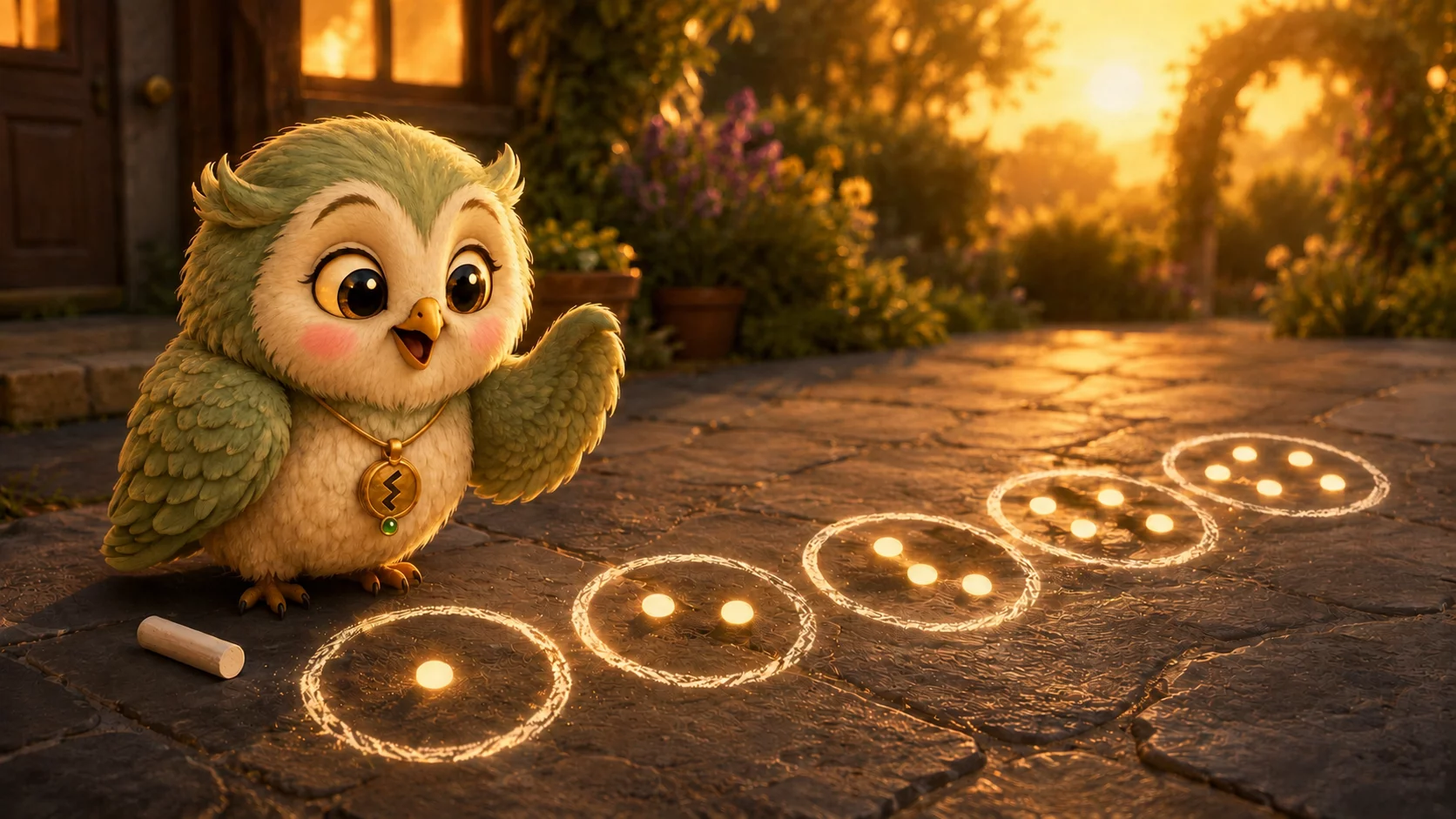
This takes one stick of chalk and about four minutes to set up, and it is the single most useful thing on this site for a three- or four-year-old.
Why chalk and not paper
On paper, five circles sit inside a hand’s width of each other. On the ground, they’re spread across six feet, and getting from the first to the last costs effort. That cost is the whole point: it turns “bigger” from a word into a distance.
Chalk also has a quality paper doesn’t. It’s temporary, it’s outdoors, and nobody marks it. A child who freezes at a worksheet will usually walk straight onto a chalk drawing.
Dots before numerals
Draw the circles, then put one dot in the first, two in the second, three in the third, and so on. Not numerals — dots.
The reason is worth knowing. The numeral 3 tells a child nothing about threeness; it’s a shape they have to be told the meaning of. Three dots are the threeness. Children who meet the quantity first and the symbol later tend to have somewhere to attach the symbol when it arrives. Do it the other way around and the symbol floats.
Arrange the dots the way they sit on a die — the pattern is recognizable at a glance, and glancing is a skill of its own.
Four games on the same five circles
Call out a number and let them jump to it. Then reverse it: you jump, they say which one you landed on. Then ask them to get from one to four in as few jumps as they can. Then stand at circle two and ask how far it is to five, before anybody moves.
That last one is the hardest and the most valuable, because it asks for a prediction rather than a count.
What to ask afterwards
One question does more than all four games: how did you know?
You’ll get answers like “it’s further” or “I did three jumps” or “because five is at the end”. Every one of those is a child telling you what they’re actually using to think with, and it’s usually not what you’d have guessed.
When the circles stop working
Same as everything else here — about a week, then the layout is memorized. Redraw them in a different order, or in a curve, or with the gaps uneven so distance and count stop agreeing. That last version is the interesting one, and it leads straight into measuring.
Free printable: Ori’s Stepping Stones — five floor tiles to cut out and lay in a line. A number path your child walks and counts out loud, one jump at a time.
No reading required · Prints clean in black and white · One task per page