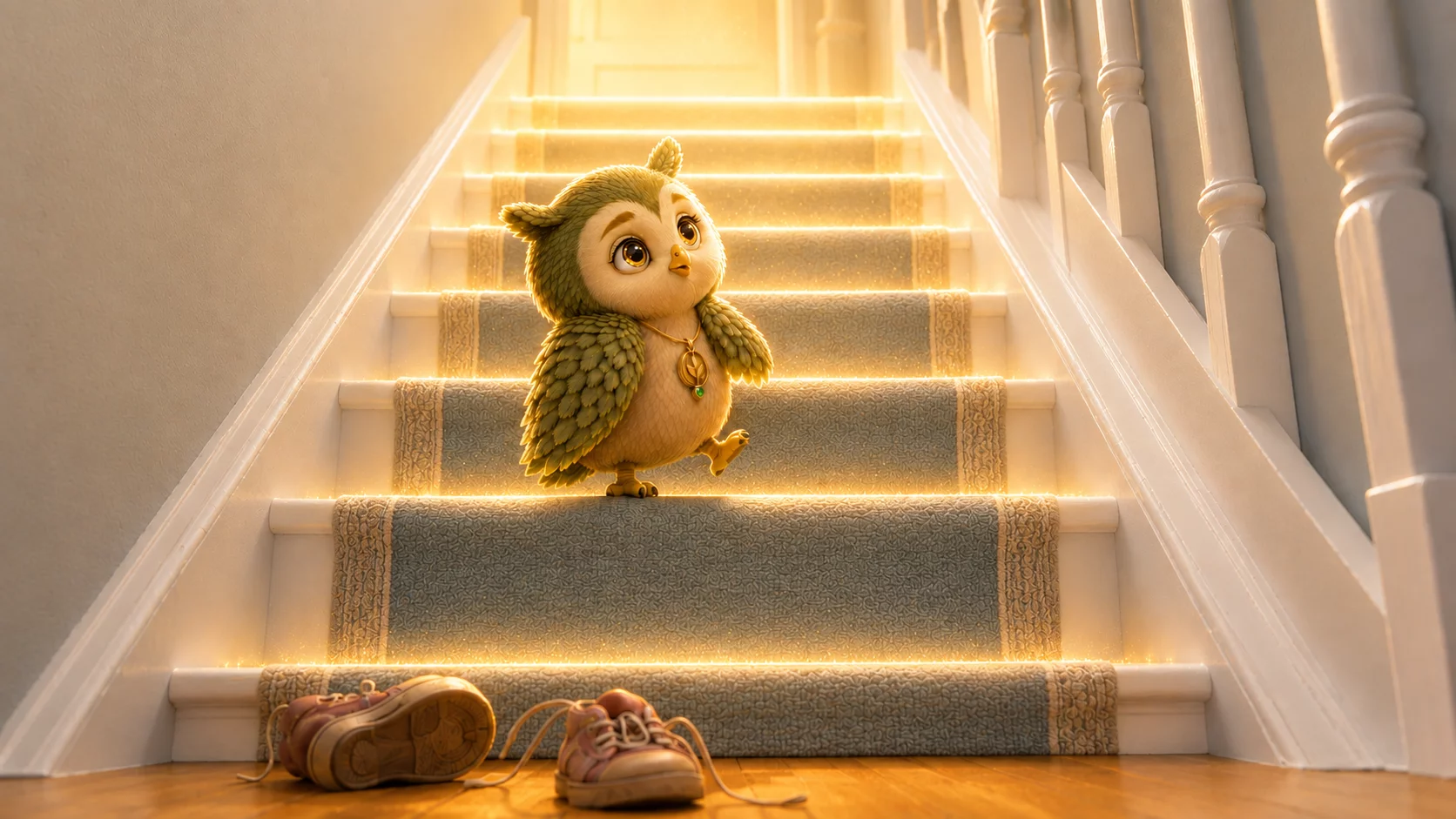
You already own the best counting equipment in the house, and you walk up it several times a day.
Why a staircase works when a page doesn’t
A staircase does three things a printed number line can’t. It gives one step per number, so the child physically cannot get ahead of themselves the way a pointing finger can. It makes the distance real — six is four steps further up than two, and the legs report that before the head does. And it repeats, in the same order, several times a day, which is how small children learn almost everything.
There’s a fourth thing, quieter than the others. Nobody is watching. Counting on the stairs doesn’t look like a lesson, so it doesn’t come with the pressure of one.
What to say on the way up
Say the numbers yourself for the first few days, one per step, unhurried. Let your child join when they want to. If they skip a number, don’t correct it in the moment — just keep your own count steady on the next flight, and they’ll usually pull themselves back into it.
Once they’re comfortable, change the question. Ask them to stop on four. Ask whether the top is closer to eight or to two. Ask how many are left. Each of these is a different piece of thinking sitting on the same fifteen steps.
The week it stops working
Somewhere around day seven, your child will “count” the staircase without looking at it. That’s memorization, not counting, and it’s completely normal — it’s what brains do with anything repeated in a fixed order.
It also means the staircase has stopped teaching. This is the moment most people push harder. The better move is to change the path.
Three ways to change the path
Count down instead of up, which is genuinely harder and worth doing slowly. Start from a step that isn’t the first one, so the count doesn’t begin at one. Or move the whole thing to a different surface — paving stones on the way to the car, floorboards across the hall, cushions laid out in a line.
Same skill, new route. The skill is the thing that transfers; the staircase never was.
If your child skips a step
Skipping is not carelessness. It’s the point where the feet run faster than the counting, and it’s one of the most useful things you can see, because it tells you exactly where the work is.
Slow the whole thing down rather than repeating it. One deliberate step, one deliberate word, with a pause you can hear between them. Speed comes back on its own once the pairing is solid; forcing speed first tends to lock the error in.
Free printable: Ori’s Stepping Stones — five floor tiles to cut out and lay in a line. A number path your child walks and counts out loud, one jump at a time.
No reading required · Prints clean in black and white · One task per page