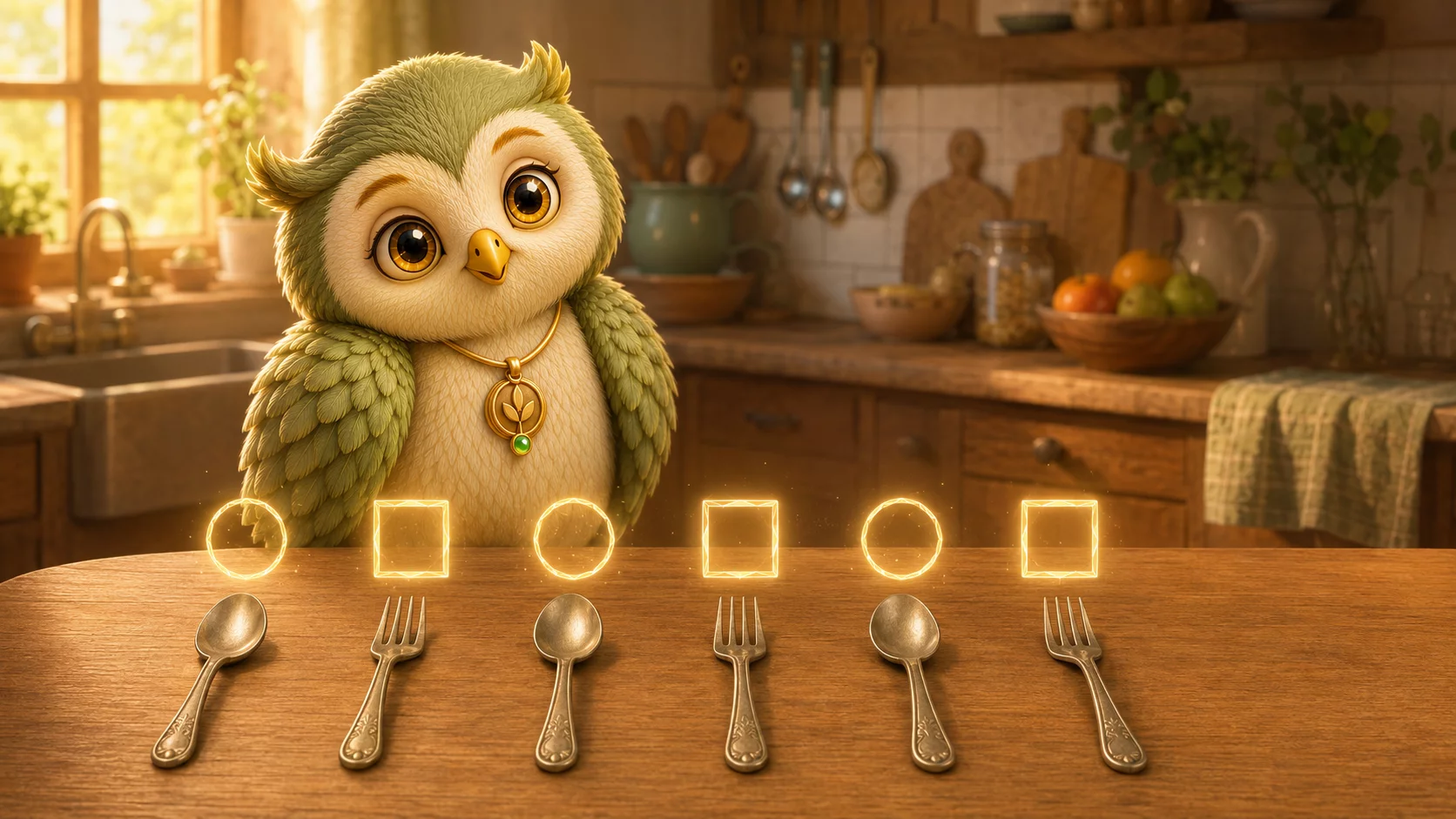
Most of us support math at home by counting. That’s how we were taught, and it isn’t wrong. But there’s a second question that builds math thinking just as much, and it takes five minutes with whatever is already on your table: what comes next?
Here’s the version that works when everyone’s tired.
What do you need for this?
Two kinds of small objects that look clearly different from each other. Silverware works. So do bottle caps, hair ties, crackers, or blocks in two colors.
You want about ten pieces total. Any more and the line runs off the table.
- Ages: 3 to 5
- Skill: noticing and continuing a simple repeating pattern
- Time: five minutes, no prep
- Cost: nothing, and no printer needed
How do you actually run it?
Lay down a line: spoon, fork, spoon, fork. Stop there and leave a gap.
Say: “I made something. Can you see what it does?”
Then wait three seconds. Longer than feels comfortable. Kids need the pause more than they need the hint.
Ask for the next one. Not two, not the rest of the line. Just one.
Say: “What goes here?”
Then ask how they knew. That’s the part that does the work.
Say: “How did you figure that out?”
Finally, hand the line over. Let your child build one for you, and you guess. Getting it wrong on purpose once is worth ten correct turns.
Say: “Is this right? Show me where I messed up.”
Why does this count as math?
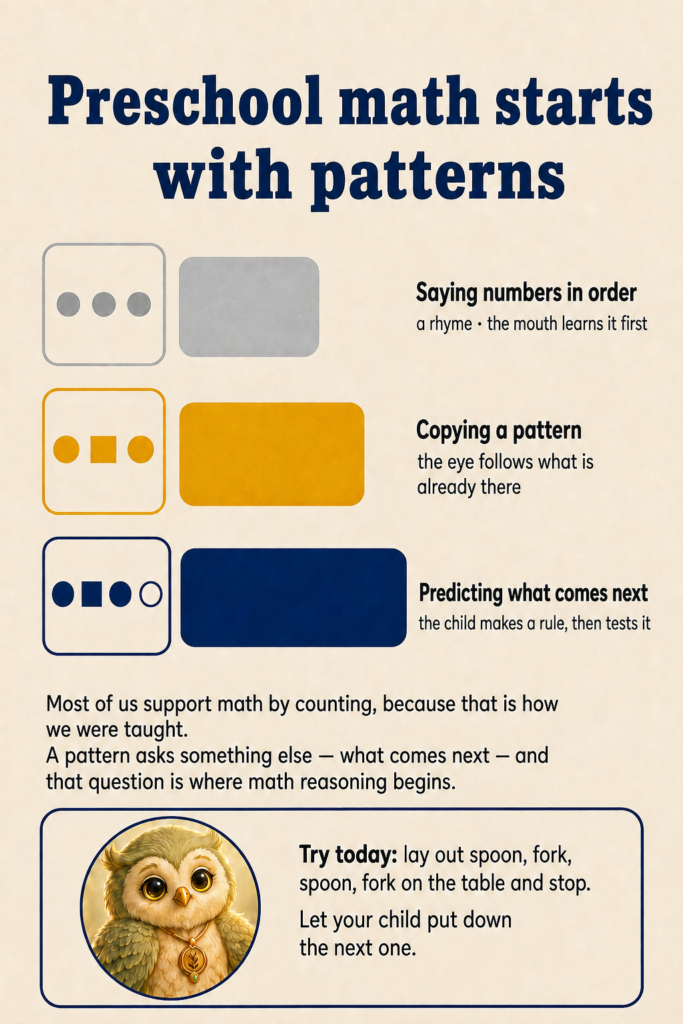
Counting teaches a child what a number is. A pattern teaches something else: that things follow rules, and that you can figure out the rule and then use it to predict.
That’s the move underneath most of school math. Not the answer, the rule that produces the answer. It’s the same noticing your child uses when you ask which one doesn’t belong and they have to justify the choice.
I want to be straight with you about the evidence. Pattern play with preschoolers is standard practice in early math teaching and it holds up in classrooms. But I don’t have a study I can point you to showing that patterning at four predicts math results later, so I won’t imply one exists.
What I can say: it costs nothing, it takes five minutes, and it gives your child a question they can answer.
How do you make it easier or harder?
Easier: repeat the pair three full times before you stop. Spoon, fork, spoon, fork, spoon, fork, then the gap. Three repetitions make the rule loud. If your child still isn’t sure, say the line out loud together while pointing.
Harder: move to AAB. Spoon, spoon, fork, spoon, spoon, fork. This one trips up plenty of five-year-olds, and that’s fine.
After AAB, try a line with a mistake hidden in it. Say: “One of these is wrong. Can you find it?” Finding the break is harder than continuing the line.
What if it doesn’t go well?
- They put down anything, randomly. They’re playing a different game, which is reasonable at four. Build the line together, saying each piece out loud, then try again tomorrow.
- They get frustrated. Shorten the line and go back to the simple pair. Say: “That one’s tricky. Want to do it together?”
- It’s over in thirty seconds. Good. That’s a complete session. Leave the objects out and let them come back to it.
- A sibling takes over. Give the older one the job of building the line for the younger one to finish.
Is this a readiness test?
No, and please don’t use it as one. A child who can’t continue a pattern at four isn’t behind, and a child who can isn’t ahead. You’re giving them something to notice, not measuring them.
If today isn’t the day for this, it’ll still be here tomorrow. The same goes for the other early skills that don’t look like math.
Free printable: Which One Doesn’t Belong — four objects on a page and one question your child answers out loud. Any answer they can explain is a right answer.
Four levels in the set · One card downloads right away, no email · Prints clean in black and white