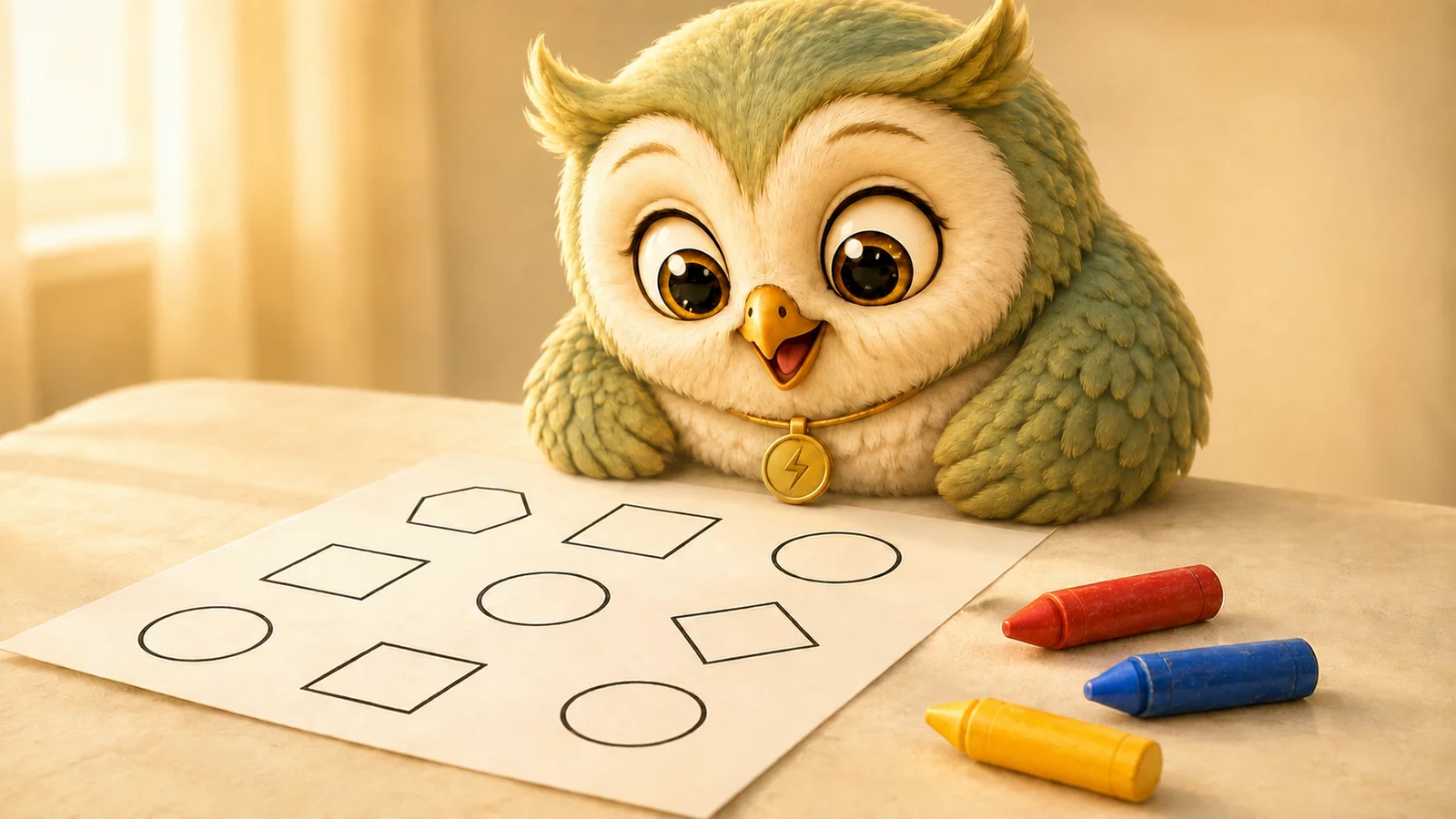
Every page we make is built for a three-year-old who cannot read yet. It sounds like a small constraint. It turned out to decide almost everything else.
No text on any page a child touches
If a page needs reading, then a child who can’t read yet needs an adult to unlock it, and the page stops being theirs. So the instructions live in a single line at the bottom, addressed to the grown-up, and everything above it works without a word.
That rules out a lot of familiar things: titles, labels, little encouraging sentences, page numbers. What’s left has to carry meaning by shape, size and position instead.
Quantity always comes before the numeral
Dots are large, numerals are small and late, and no page asks a child to work with a symbol before they’ve handled the quantity it stands for. On most pages the numeral doesn’t appear at all.
This is the same idea as chalk circles filled with dots rather than numbers. The symbol is easy to add later, once there’s something for it to attach to.
Meaning is never carried by color
If two things need to be different, they differ in shape or size — never only in color. Partly because a fair number of people see color differently, and partly for a much more ordinary reason: most of these pages get printed on a home printer, often in plain black and white, and anything that relied on color would simply stop working.
There’s no gold or silver anywhere for the same reason. They look like nothing on a home printer.
Thick lines, wide spaces, nothing that moves
Lines are thick and spaces are wide, because a small hand holding a fat crayon needs room to be inaccurate. Anything a child is meant to draw inside has a pale, empty middle — a dark filled shape can’t be drawn on and drinks ink besides.
And the layout never moves. The owl sits in the same corner on every page, so nobody has to work out where to start.
One task per page
A page with three things on it asks a child to choose before they can begin, and choosing is its own kind of work. One task per page removes that step entirely.
It also means a page can be finished. A child who completes one page has completed something, which is a different feeling from stopping halfway down a sheet. More on all of this on the how we make these page.
Free printable: Ori’s Stepping Stones — five floor tiles to cut out and lay in a line. A number path your child walks and counts out loud, one jump at a time.
No reading required · Prints clean in black and white · One task per page