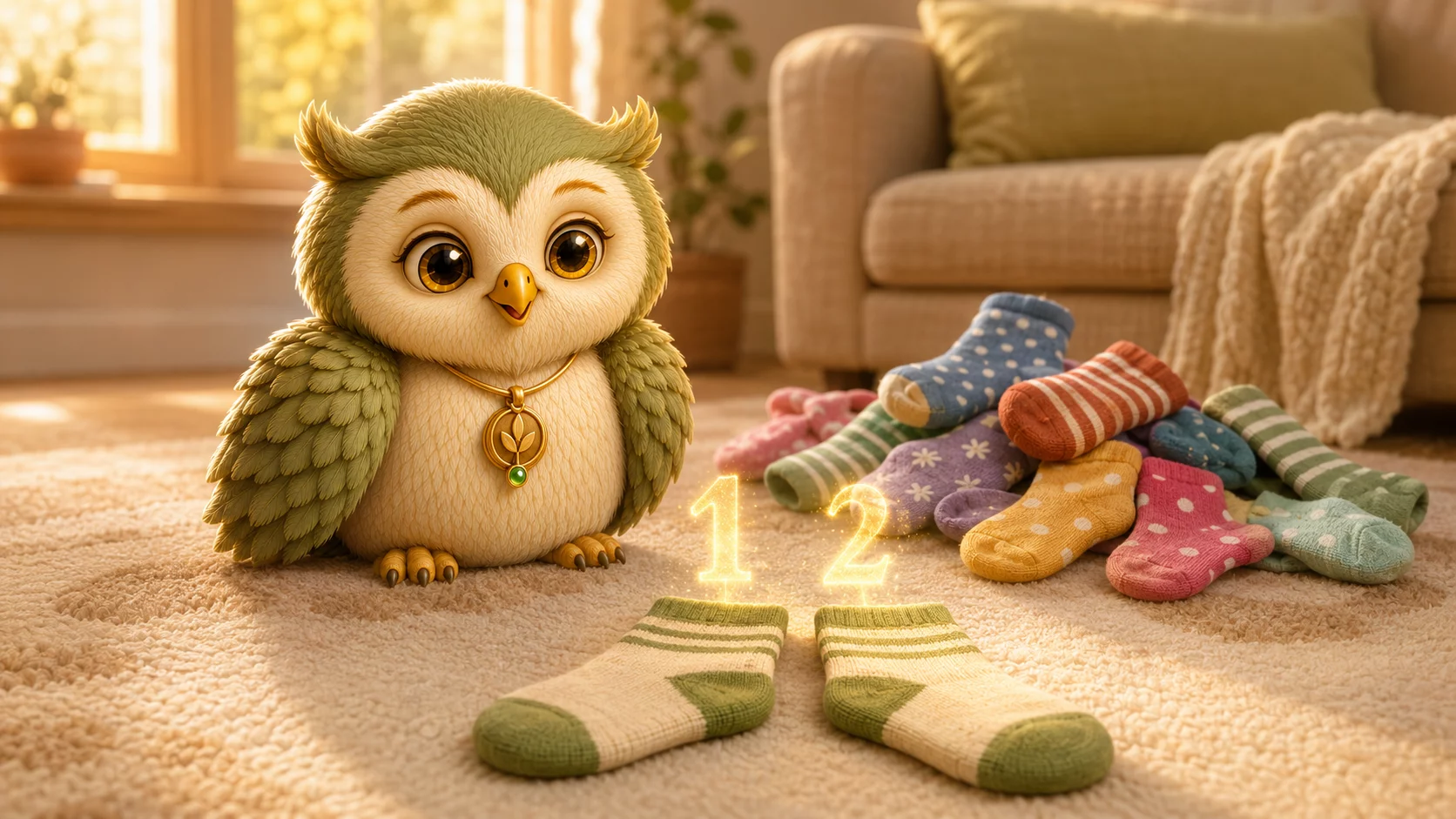
A lot, as long as nobody hands them a crayon. At 2.5, math is same-and-different, more-and-less, and putting one thing on top of another thing. Those are the roots of counting, and they happen with socks, cups, and snack.
Here’s what’s common at this age, what you can leave for later, and what five minutes of it looks like on a Tuesday.
What’s common at 2.5?
Common, not required. Kids this age vary a lot, and a child who does two of these and none of the others is a normal Tuesday.
- Matching: finds the sock that’s the same as the one you’re holding. Same shoe, same cup, same block.
- Sorting by one thing: spoons here, forks there. Red blocks in this bowl. One feature at a time.
- “More” when it’s obvious: two crackers next to a big pile. She’ll point to the pile. Close calls come much later.
- Some number words: often out of order, often “two” for anything that’s more than one. That’s the word arriving before the amount.
- One on each: a spoon on each plate, roughly. Some doubled up, some missed. The intent is there.
Every one of these is math. None of them looks like it, which is why it’s easy to feel like nothing is happening.
What can I skip for now?
Written numerals. A 2.5-year-old can learn that a squiggle is called “three” the way she learns a dog is called “dog.” It doesn’t connect to three of anything yet. Save it.
Worksheets that need a crayon. Here’s the fair case for them: they give you a sit-down moment, a clear task, and something to show for it. All true. The catch is that at this age a page measures hands, not head. A child who understands “more” and can’t yet hold a crayon steady looks like she doesn’t get it. Keep the sit-down moment. Swap the crayon for a finger or a real object she can put on the page.
Counting past what she can see. Reciting to ten is fine as a song. Counting means things, and three is plenty of things.
Anything with a timer. Including you, quietly timing.
What do five minutes look like?
Pick one. You don’t do all three; you do one, and you stop while it’s still fun.
- The twin hunt. Dump the clean socks on the rug. Hold one up: “Find the one that’s the same.” When she brings it: “Same!” Lay the pair side by side. Three pairs is a full round.
- Snack plates. Two plates, two crackers on one, a big handful on the other. “Which one has more?” Then she picks which to eat from. That’s the reward built in.
- One on each. Three plates, three strawberries. “One for each plate.” If she doubles up, say “this plate is empty” and let her fix it.
Say what she did, not that she’s smart: “You found the same one.” That’s the whole script.
Shapes fit right into this age too, because a circle and a square are just “same” and “different” with a name. There’s a walk-through in space and shapes at home.
How do I know it’s working?
It looks like play, so you have to watch for small things. She says “same!” without being asked. She notices a plate is empty. She hands you two when you say “two” and it’s actually two. Those are the signs, and they show up across months, not days.
If snack plates become a favorite, the next step is the one where amount and space stop matching, and we wrote that up in more or less before counting.
Free printable: Find the Twin — acorns, leaves, and pinecones in two columns. Your child finds each one’s twin and draws a line between them; at the youngest level, no crayon, just point or put a real leaf on the match. Four levels from 2.5 to 7, up to 4 pairs. The age-4 page is free; the full set comes by email.
No reading required · Prints clean in black and white · One task per page