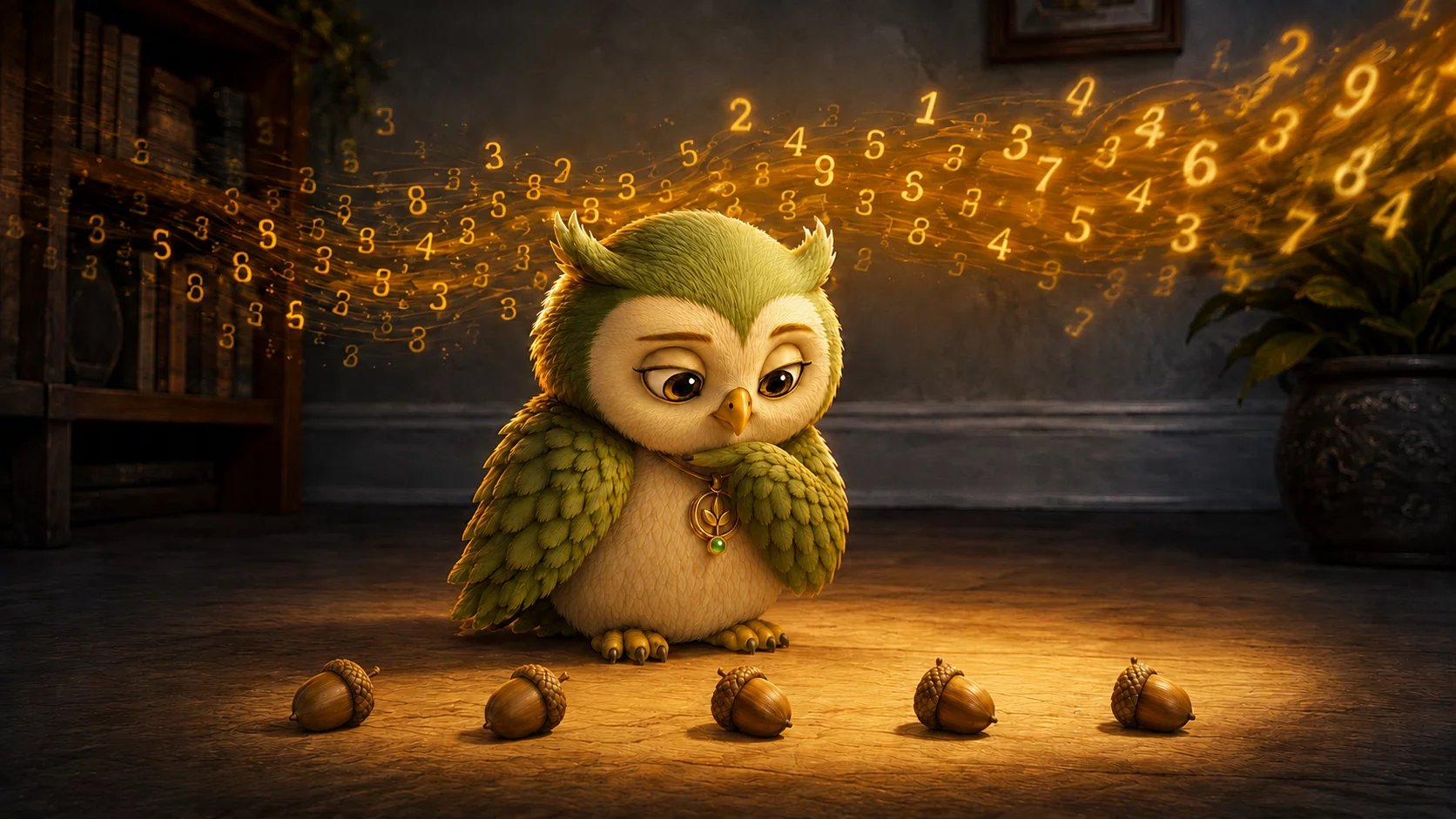
A child who can rattle off one to twenty sounds like a child who can count. Often they are — and just as often, the two things have come apart, and the recital is running well ahead of the understanding underneath it.
This is not a problem to fix. It’s a normal stage, and it’s worth being able to see.
Reciting is a song
The number sequence arrives the way song lyrics arrive: as a string of sounds in a fixed order, learned by repetition, produced automatically. That’s genuinely useful — the sequence has to be there before it can be used for anything. But knowing the words doesn’t yet mean knowing what they point at.
You can hear the seam if you listen for it. A child running the recital will keep going smoothly past the objects, or stop when the song ends rather than when the objects do.
What quantity feels like
The other half is quantity: knowing that seven things is more stuff than five things, that the last number you say is how many there are, that the total doesn’t change if you count the same things starting from the other end.
That half doesn’t come from repeating the sequence more often. It comes from handling quantities — moving them, comparing them, walking through them.
The walking test
Here’s a two-minute way to see where your child is. Ask them to take five steps across the room, then seven, and ask which one took longer. A child who has the quantity will answer without hesitating. A child who has only the song may look puzzled, or guess.
Either answer is fine. It just tells you which half to spend time on this week.
Why this isn’t a delay
Almost every child goes through a stretch where the recital outruns the meaning. It’s what you’d expect from something learned by ear before it’s learned by hand. Your child is exactly where they should be, and there is nothing here to catch up on.
What to do instead of more reciting
Stop asking “how many?” for a while and start asking “which has more?” — two piles of anything, no counting allowed. Put five things somewhere they have to walk to, so the quantity costs something. Count things you can’t pick up: steps, doors, lampposts on the way to the store.
All of it builds the half that reciting doesn’t touch, and none of it needs a worksheet.
Free printable: Ori’s Stepping Stones — five floor tiles to cut out and lay in a line. A number path your child walks and counts out loud, one jump at a time.
No reading required · Prints clean in black and white · One task per page